


Arcadia: The Digital Compass Turning Ideas into Technology
What is Arcadia? Discover how Inferent’s digital consulting company combines strategy, design, software, and responsible AI to turn ambitious ideas into products that can grow.
Editorial focus. This long-form guide answers what Arcadia is, how it works inside Inferent and when its method is useful. It is written for leaders, product teams, founders and operators who need a clear route from an idea to a service that can be used, measured and improved.
The short answer: what Arcadia is
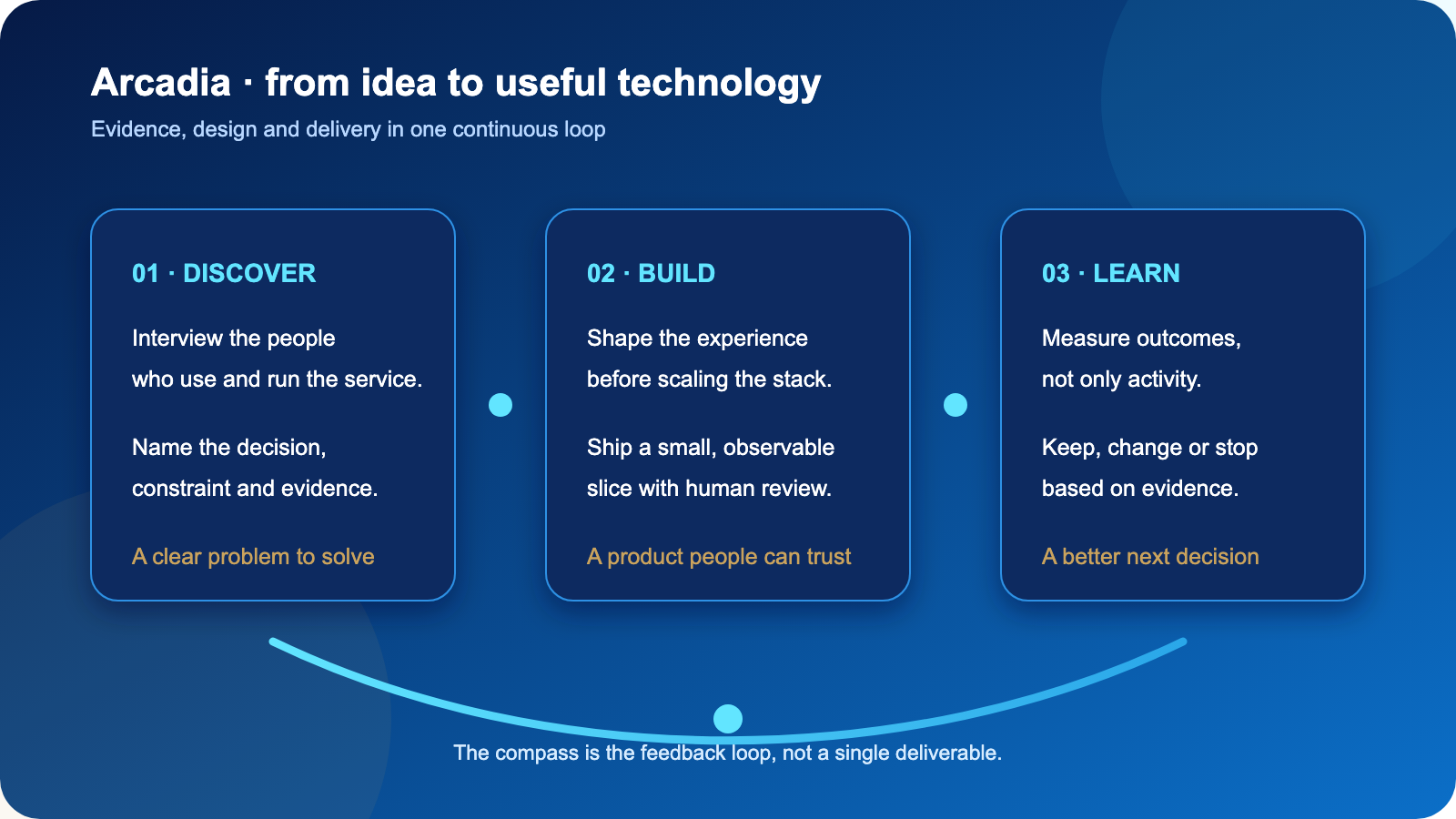
Arcadia is Inferent’s digital consulting and product-development company. It brings together business strategy, service design, software engineering, communication and responsible artificial intelligence in one accountable practice. The point is not to add technology for its own sake. The point is to help a team decide what should exist, why it matters, how it will work in the real world and what evidence should determine the next investment. That is why this article calls Arcadia a digital compass: the compass gives direction while the team still owns the destination.
A client can arrive with a rough idea, an outdated process, a product that has stopped growing or a new capability that needs a safe route into production. Arcadia starts by making the situation legible. It clarifies users, constraints, economics, risks and the smallest change worth testing. From there, the work may become a service blueprint, a new web product, an internal tool, a data workflow, an AI-assisted experience or a longer transformation roadmap. The deliverable changes; the discipline stays consistent.
Arcadia inside the Inferent ecosystem
Arcadia operates inside the wider Inferent research and editorial ecosystem. That relationship matters because research supplies questions and evidence, while Arcadia turns validated opportunities into products, services and operating habits. The two activities are complementary, not interchangeable: a research note can reveal a need, but it does not by itself create an onboarding flow, an observability plan or a support model. Arcadia is the bridge between insight and sustained use.
The company’s public home, arcadia.inferent.xyz, presents the same idea from a service perspective. Arcadia Consulting, Arcadia Creators and Arcadia Suite serve different moments in a team’s journey. Consulting addresses direction and delivery; Creators gives founders structured support; Suite packages recurring operational needs. Together they make a portfolio rather than a single agency offer.
The problem Arcadia is designed to solve
Many digital projects fail before engineering begins. The brief is too broad, different stakeholders use the same word for different outcomes, the user is treated as a persona instead of a participant, or a pilot is judged by activity rather than value. Other projects fail later: the prototype works but cannot be maintained, the team cannot explain a model’s behavior, or the economics collapse when usage increases. Arcadia’s work is designed around those handoffs, because a useful product is a chain of decisions rather than a single launch.
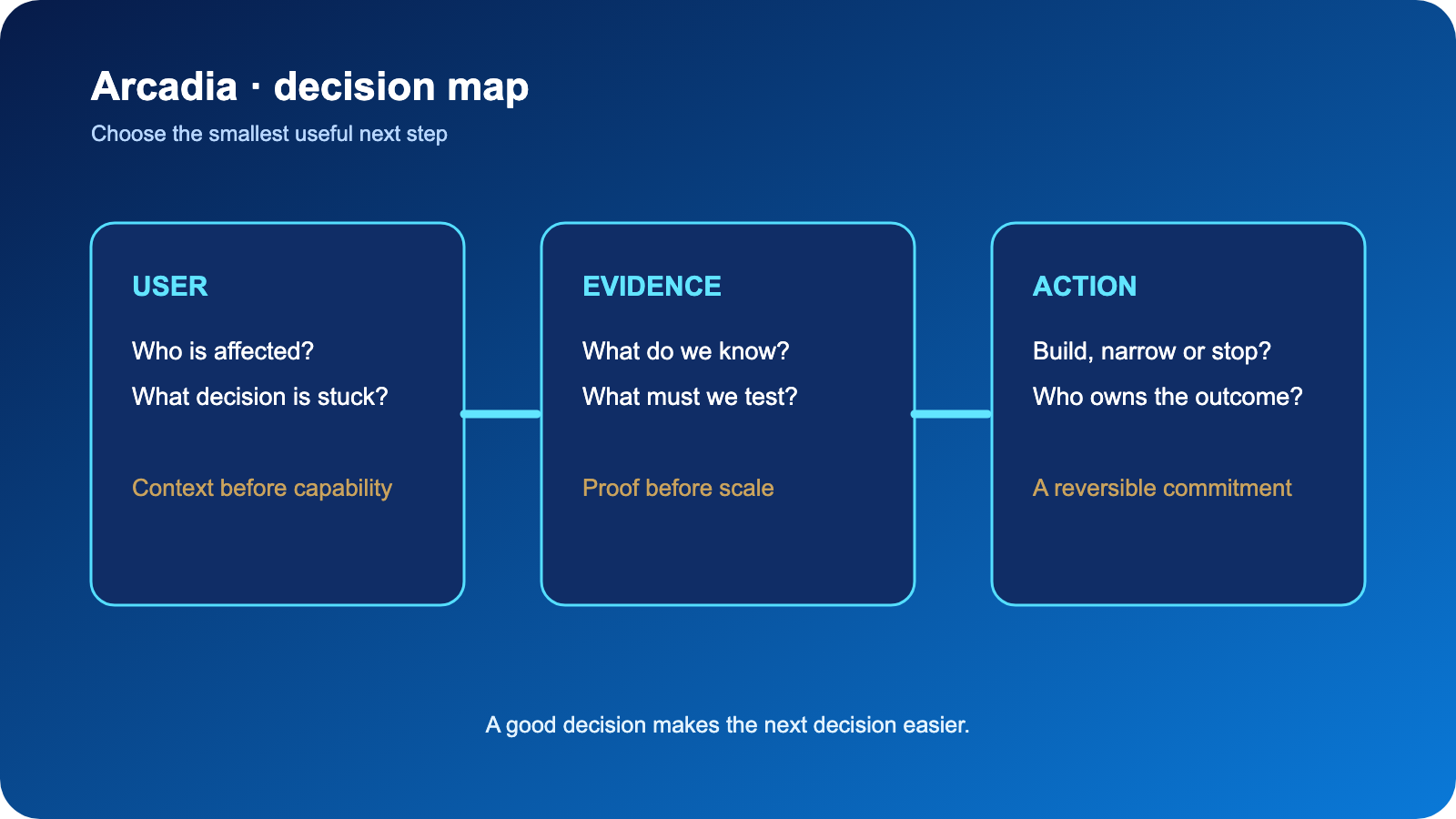
The first question is therefore not “which tool should we buy?” It is “which decision are we trying to improve?” A decision could be a customer choosing a plan, an operator resolving an exception, a student preparing for an exam, a founder prioritizing a roadmap or a leadership team allocating scarce capacity. Once that decision is explicit, Arcadia can choose an appropriate research method, interface, architecture and measurement plan instead of forcing every problem into the same technology pattern.
Strategy before software
Arcadia’s strategy work is concrete. It maps the current service, identifies the moments where value or trust is lost, and turns assumptions into testable hypotheses. The output is not a deck that sits on a shelf; it is a sequence of decisions with owners, dependencies, guardrails and a definition of “good enough.” Where necessary, the team models three horizons: what can improve this quarter, what requires a platform decision and what should remain deliberately out of scope.
This approach protects a client from two expensive extremes. Building too soon creates rework and unowned complexity. Planning forever creates a polished diagnosis with no learning loop. Arcadia uses short cycles: interview, frame, prototype, test, decide. A strong brief can fit on one page if it names the user, the job, the constraint, the expected behavior, the success signal and the stop condition. The detail comes from evidence, not from extra jargon.
Designing the experience and the service
A digital product is more than its interface. Arcadia maps the frontstage—the screen, message or interaction a person sees—and the backstage—the data, people, approvals and systems that make that moment possible. This is especially important for products that combine automation with human support. A clear escalation path is part of the experience; so are empty states, error messages, accessibility, language, consent and the ability to undo a consequential action.
Design decisions are tested against real tasks, not only visual preference. A prototype should make a risk visible early: can a new user understand the next step, can an operator recover from a bad input, can a person tell what the system knows, and can the organization support the promise at the expected volume? The result is a calmer product because the hard moments were designed instead of left to customer support.
Engineering a product that can grow
Arcadia’s software practice connects product intent to an architecture that a team can own. That usually means defining boundaries, choosing the simplest reliable data model, documenting interfaces and instrumenting the path that matters. Performance is considered alongside security, deployment, cost and maintainability. A fast demo that cannot be observed is not a product milestone; it is an unanswered question.
Delivery is intentionally incremental. A first slice should be valuable on its own, expose the riskiest assumption and leave a clean path for the next slice. Code review, automated checks, environment separation, backups and rollback plans are not ceremonial gates; they are ways to keep learning reversible. When a client already has a stack, Arcadia works with its constraints rather than proposing a wholesale rewrite without evidence.
Responsible AI as a product requirement
When a project includes AI, Arcadia treats responsibility as a design and engineering requirement. The team defines what the system may do, what it must never do, what information it may use, when a person must review the output and how an incident will be detected. Evaluation covers representative tasks, uncertainty, bias, privacy, latency and cost. A model is only one component; the surrounding permissions, prompts, retrieval, interface and support process shape the actual risk.
This is why Arcadia avoids presenting automation as magic. A helpful assistant can cite its sources, signal uncertainty, ask for clarification and hand a decision to a person. A high-impact workflow may require approval before an external action. If a use case cannot meet those conditions, the correct decision may be to narrow it, delay it or not build it. Responsible innovation is still innovation; it simply makes the boundaries visible.
Arcadia Suite and recurring operations
Some teams do not need a bespoke transformation project; they need fewer operational gaps every week. Arcadia Suite is positioned as an all-in-one platform for client management, project tracking, billing and collaboration. The strategic value is not the label “all-in-one.” It is the possibility of connecting a repeatable workflow so that handoffs, status, ownership and revenue are visible in one place. That visibility creates better data for the next process improvement.
A platform should still be introduced with restraint. Before configuration, the team decides which workflow is stable enough to standardize, which exceptions deserve a human path and which metrics will prove that the tool is helping. Adoption is part of the product: templates, permissions, training, migration and feedback must be planned alongside features. The result should feel lighter for the people doing the work, not like an additional reporting obligation.
Arcadia Creators and the founder journey
Arcadia Creators extends the practice to founders and emerging teams. The program combines guidance, product thinking, technology, positioning and access to specialists so that an idea can become an investable, usable and maintainable company. The important distinction is that Creators does not replace the founder’s judgment. It adds structure around the decisions that are hardest to make alone: who to serve first, what to validate, what to build, what to measure and when to change course.
For an early-stage team, the best outcome may be a sharper problem statement, a tested prototype and a credible operating plan rather than a large application. Arcadia helps keep the first version narrow enough to learn and strong enough to earn the next conversation with users, partners or investors. More about the program is available on the Arcadia Creators page; the principle is the same as in larger engagements: evidence earns the next commitment.
How an Arcadia engagement moves
A typical engagement begins with a discovery sprint. Stakeholders, users and operators are interviewed; existing analytics and documents are reviewed; the service is mapped; and the team agrees on the decision that matters. A diagnosis then turns the observations into a prioritized opportunity map. The next stage is a thin prototype or technical spike, chosen to answer the most expensive unknown before a larger build begins.
After validation, Arcadia moves into delivery with a shared backlog and explicit acceptance signals. Product, design and engineering stay connected through regular reviews; operations and governance are included before launch; and the measurement plan is implemented with the feature, not after it. At the end of a cycle, the team decides to scale, revise, pause or stop. That decision is the real unit of progress.
Measuring value without reducing it to vanity metrics
Arcadia uses a balanced scorecard. Business measures might include qualified demand, activation, retention, margin or time saved. Experience measures might include task completion, comprehension, accessibility and support contacts. Capability measures might include deployment frequency, recovery time, data quality or the percentage of decisions that have an owner. Trust measures might include consent coverage, override rates, incident response and the visibility of model limitations.
The exact numbers depend on the service, but the logic is stable: define a baseline, choose a leading signal and pair it with a guardrail. If an automation increases throughput while error corrections double, the system has not improved. If a redesign reduces clicks but makes a high-stakes choice harder to understand, the metric is incomplete. Measurement keeps the conversation honest without pretending that every human outcome can be reduced to one score.
A practical 90-day route
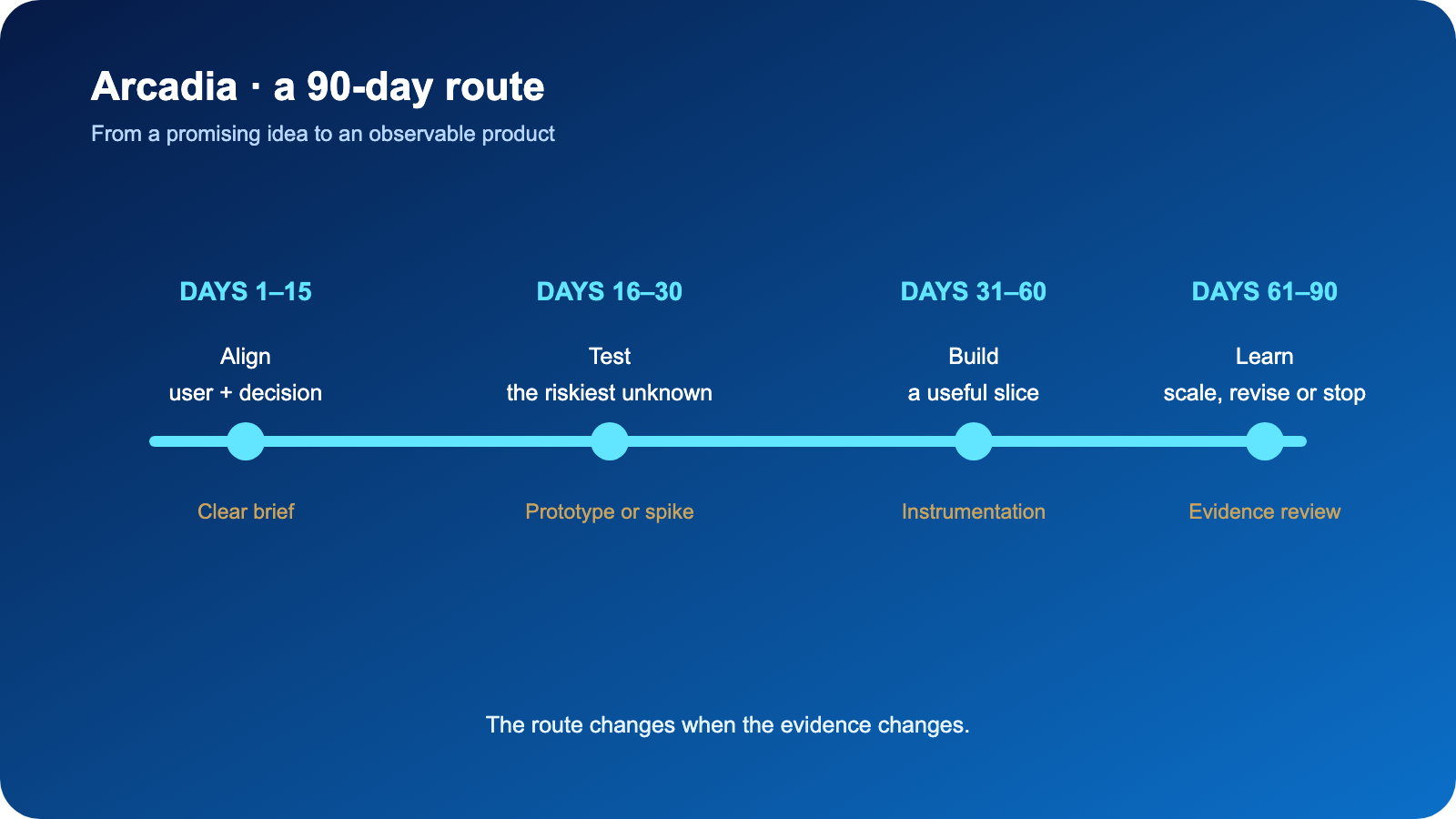
During days 1–15, the team aligns on the user, the decision and the constraint. During days 16–30, it collects evidence and tests the riskiest assumption with a prototype, workflow or technical spike. During days 31–60, it builds the smallest useful slice, adds instrumentation and rehearses the support path. During days 61–90, it releases to a controlled group, reviews the evidence and chooses the next investment. The sequence is short enough to preserve urgency and explicit enough to prevent accidental scope.
The route changes when the evidence changes. A team can discover that the problem is a policy issue, not a software issue; that a manual process is better than automation for now; or that a different user needs to be served first. Arcadia’s value is partly the confidence to make those calls early. A stopped project with a clear reason can be a successful outcome if it protects time, money and trust.
When Arcadia is the right partner
Arcadia is a good fit when a team needs to connect strategy with execution, when a digital service crosses organizational boundaries, or when an AI idea needs a responsible route into daily work. It is also useful when a founder or leadership team has momentum but not yet a shared product language. The engagement can be narrow—a diagnosis, prototype or architecture review—or broad enough to accompany a product through launch and learning.
It is not a substitute for domain accountability. The client still owns the policy, the customer relationship, the data rights and the final business decision. Arcadia contributes a method, specialized capabilities and a transparent record of trade-offs. That division of responsibility is a feature, not a disclaimer: the product is more durable when the people who operate it can explain it.
Arcadia readiness checklist
- We can name the user and the decision the product should improve.
- We know the constraint that could make the idea fail.
- We have a baseline and a signal for learning.
- A person owns policy, data, delivery and support.
- The first release has a rollback or stop condition.
- AI use is bounded by permissions, review and evidence.
Frequently asked questions
Is Arcadia an agency?
Arcadia can deliver creative and technical work, but its role is broader: it connects diagnosis, product decisions, engineering and measurable adoption.
Does Arcadia only work with startups?
No. Arcadia works with founders, established organizations and teams inside Inferent’s ecosystem; the scope is adapted to the maturity and constraints of each project.
Does every project need artificial intelligence?
No. AI is used when it improves the decision or experience and when its risk can be governed. A simpler workflow is often the better product.
What should a first conversation include?
Bring the current situation, the user or operator affected, the decision that feels stuck and any evidence already available. A perfect brief is not required.
Executive thesis
What changes in practice
In Arcadia Consulting, discovery, product architecture, communication, and measurable delivery is not a decorative detail. It changes how a team defines the user problem, chooses evidence, assigns responsibility, and decides what a good outcome looks like. The useful move is to name the decision, the constraint, and the failure that would be costly to discover late. That framing turns a headline into an operating question that designers, engineers, operators, and leaders can improve together.
A practical way to work through strategy, design, software development, and responsible AI is to separate the promise from the mechanism. The promise describes the improvement a person should feel; the mechanism explains what the system must do; the evidence shows whether the improvement survives ordinary use. This distinction keeps the Arcadia operating model from becoming a collection of impressive demonstrations. It also gives the team a shared language for deciding what to build next and what to leave out.
The attractive story about Arcadia Consulting usually begins with a capability. The harder story begins with a situation: a person has limited time, incomplete information, and a consequence attached to the decision. the Arcadia operating model matters because it changes that situation, not because it adds another feature. A serious plan therefore describes the before and after in observable terms, including the moments when the system should stay quiet, ask for help, or hand control back.
Evidence changes the conversation around Executive thesis. Instead of asking whether the idea sounds advanced, the team can ask whether users complete the important task more reliably, whether operators can explain a failure, and whether the cost remains compatible with the value created. Those questions are deliberately ordinary. They protect the work from both hype and cynicism by making progress visible in the behavior of the whole service.
Teams often underestimate the amount of coordination hidden inside the Arcadia operating model. Product language, interface decisions, data handling, infrastructure, support, and governance all shape the same user experience. If one layer contradicts another, the product feels unreliable even when each component works in isolation. A useful operating rhythm brings these perspectives together early, records the trade-off, and revisits it when new evidence changes the original assumption.
There is an economic dimension to Arcadia delivery model that cannot be postponed until after adoption. Every interaction has a cost in compute, attention, maintenance, support, or trust. A strong design makes that cost legible and chooses where precision matters most. It may use a simpler path for routine cases, reserve expensive capability for high-value decisions, and measure the full service rather than celebrating a single technical metric.
Responsible execution does not mean removing all uncertainty from Arcadia Consulting. It means deciding which uncertainty is acceptable, which one needs a person, and which one should stop the workflow. That distinction makes the system more resilient. It also makes the product easier to explain to customers, colleagues, and future maintainers because the boundaries are part of the design instead of an apology added after an incident.
The question behind the headline
A decision rule
A practical way to work through a digital compass that helps organizations turn ideas into technology with direction is to separate the promise from the mechanism. The promise describes the improvement a person should feel; the mechanism explains what the system must do; the evidence shows whether the improvement survives ordinary use. This distinction keeps the Arcadia operating model from becoming a collection of impressive demonstrations. It also gives the team a shared language for deciding what to build next and what to leave out.
The attractive story about Arcadia Consulting usually begins with a capability. The harder story begins with a situation: a person has limited time, incomplete information, and a consequence attached to the decision. Arcadia Consulting matters because it changes that situation, not because it adds another feature. A serious plan therefore describes the before and after in observable terms, including the moments when the system should stay quiet, ask for help, or hand control back.
Evidence changes the conversation around The question behind the headline. Instead of asking whether the idea sounds advanced, the team can ask whether users complete the important task more reliably, whether operators can explain a failure, and whether the cost remains compatible with the value created. Those questions are deliberately ordinary. They protect the work from both hype and cynicism by making progress visible in the behavior of the whole service.
Teams often underestimate the amount of coordination hidden inside Arcadia Consulting. Product language, interface decisions, data handling, infrastructure, support, and governance all shape the same user experience. If one layer contradicts another, the product feels unreliable even when each component works in isolation. A useful operating rhythm brings these perspectives together early, records the trade-off, and revisits it when new evidence changes the original assumption.
There is an economic dimension to Arcadia delivery model that cannot be postponed until after adoption. Every interaction has a cost in compute, attention, maintenance, support, or trust. A strong design makes that cost legible and chooses where precision matters most. It may use a simpler path for routine cases, reserve expensive capability for high-value decisions, and measure the full service rather than celebrating a single technical metric.
Responsible execution does not mean removing all uncertainty from Arcadia Consulting. It means deciding which uncertainty is acceptable, which one needs a person, and which one should stop the workflow. That distinction makes the system more resilient. It also makes the product easier to explain to customers, colleagues, and future maintainers because the boundaries are part of the design instead of an apology added after an incident.
In the Arcadia operating model, the Arcadia operating model is not a decorative detail. It changes how a team defines the user problem, chooses evidence, assigns responsibility, and decides what a good outcome looks like. The useful move is to name the decision, the constraint, and the failure that would be costly to discover late. That framing turns a headline into an operating question that designers, engineers, operators, and leaders can improve together.
The goal is not to make technology look inevitable. The goal is to make its consequences clear enough that people can choose well.
Definitions and boundaries
The detail people miss
The attractive story about Arcadia Consulting usually begins with a capability. The harder story begins with a situation: a person has limited time, incomplete information, and a consequence attached to the decision. Arcadia delivery model matters because it changes that situation, not because it adds another feature. A serious plan therefore describes the before and after in observable terms, including the moments when the system should stay quiet, ask for help, or hand control back.
Evidence changes the conversation around Definitions and boundaries. Instead of asking whether the idea sounds advanced, the team can ask whether users complete the important task more reliably, whether operators can explain a failure, and whether the cost remains compatible with the value created. Those questions are deliberately ordinary. They protect the work from both hype and cynicism by making progress visible in the behavior of the whole service.
Teams often underestimate the amount of coordination hidden inside Arcadia delivery model. Product language, interface decisions, data handling, infrastructure, support, and governance all shape the same user experience. If one layer contradicts another, the product feels unreliable even when each component works in isolation. A useful operating rhythm brings these perspectives together early, records the trade-off, and revisits it when new evidence changes the original assumption.
There is an economic dimension to Arcadia delivery model that cannot be postponed until after adoption. Every interaction has a cost in compute, attention, maintenance, support, or trust. A strong design makes that cost legible and chooses where precision matters most. It may use a simpler path for routine cases, reserve expensive capability for high-value decisions, and measure the full service rather than celebrating a single technical metric.
Responsible execution does not mean removing all uncertainty from Arcadia Consulting. It means deciding which uncertainty is acceptable, which one needs a person, and which one should stop the workflow. That distinction makes the system more resilient. It also makes the product easier to explain to customers, colleagues, and future maintainers because the boundaries are part of the design instead of an apology added after an incident.
In the Arcadia operating model, Arcadia Consulting is not a decorative detail. It changes how a team defines the user problem, chooses evidence, assigns responsibility, and decides what a good outcome looks like. The useful move is to name the decision, the constraint, and the failure that would be costly to discover late. That framing turns a headline into an operating question that designers, engineers, operators, and leaders can improve together.
A practical way to work through Arcadia delivery model is to separate the promise from the mechanism. The promise describes the improvement a person should feel; the mechanism explains what the system must do; the evidence shows whether the improvement survives ordinary use. This distinction keeps Arcadia Consulting from becoming a collection of impressive demonstrations. It also gives the team a shared language for deciding what to build next and what to leave out.
Operating model
From promise to behavior
Evidence changes the conversation around Operating model. Instead of asking whether the idea sounds advanced, the team can ask whether users complete the important task more reliably, whether operators can explain a failure, and whether the cost remains compatible with the value created. Those questions are deliberately ordinary. They protect the work from both hype and cynicism by making progress visible in the behavior of the whole service.
Teams often underestimate the amount of coordination hidden inside discovery, product architecture, communication, and measurable delivery. Product language, interface decisions, data handling, infrastructure, support, and governance all shape the same user experience. If one layer contradicts another, the product feels unreliable even when each component works in isolation. A useful operating rhythm brings these perspectives together early, records the trade-off, and revisits it when new evidence changes the original assumption.
There is an economic dimension to Arcadia delivery model that cannot be postponed until after adoption. Every interaction has a cost in compute, attention, maintenance, support, or trust. A strong design makes that cost legible and chooses where precision matters most. It may use a simpler path for routine cases, reserve expensive capability for high-value decisions, and measure the full service rather than celebrating a single technical metric.
Responsible execution does not mean removing all uncertainty from Arcadia Consulting. It means deciding which uncertainty is acceptable, which one needs a person, and which one should stop the workflow. That distinction makes the system more resilient. It also makes the product easier to explain to customers, colleagues, and future maintainers because the boundaries are part of the design instead of an apology added after an incident.
In the Arcadia operating model, a digital compass that helps organizations turn ideas into technology with direction is not a decorative detail. It changes how a team defines the user problem, chooses evidence, assigns responsibility, and decides what a good outcome looks like. The useful move is to name the decision, the constraint, and the failure that would be costly to discover late. That framing turns a headline into an operating question that designers, engineers, operators, and leaders can improve together.
A practical way to work through the Arcadia operating model is to separate the promise from the mechanism. The promise describes the improvement a person should feel; the mechanism explains what the system must do; the evidence shows whether the improvement survives ordinary use. This distinction keeps Arcadia Consulting from becoming a collection of impressive demonstrations. It also gives the team a shared language for deciding what to build next and what to leave out.
The attractive story about Arcadia delivery model usually begins with a capability. The harder story begins with a situation: a person has limited time, incomplete information, and a consequence attached to the decision. a routing layer that chooses capability without confusing the user matters because it changes that situation, not because it adds another feature. A serious plan therefore describes the before and after in observable terms, including the moments when the system should stay quiet, ask for help, or hand control back.
Architecture and workflow
A system view
Teams often underestimate the amount of coordination hidden inside Arcadia Consulting. Product language, interface decisions, data handling, infrastructure, support, and governance all shape the same user experience. If one layer contradicts another, the product feels unreliable even when each component works in isolation. A useful operating rhythm brings these perspectives together early, records the trade-off, and revisits it when new evidence changes the original assumption.
There is an economic dimension to Arcadia Consulting that cannot be postponed until after adoption. Every interaction has a cost in compute, attention, maintenance, support, or trust. A strong design makes that cost legible and chooses where precision matters most. It may use a simpler path for routine cases, reserve expensive capability for high-value decisions, and measure the full service rather than celebrating a single technical metric.
Responsible execution does not mean removing all uncertainty from the Arcadia operating model. It means deciding which uncertainty is acceptable, which one needs a person, and which one should stop the workflow. That distinction makes the system more resilient. It also makes the product easier to explain to customers, colleagues, and future maintainers because the boundaries are part of the design instead of an apology added after an incident.
In Arcadia Consulting, the Arcadia operating model is not a decorative detail. It changes how a team defines the user problem, chooses evidence, assigns responsibility, and decides what a good outcome looks like. The useful move is to name the decision, the constraint, and the failure that would be costly to discover late. That framing turns a headline into an operating question that designers, engineers, operators, and leaders can improve together.
A practical way to work through a routing layer that chooses capability without confusing the user is to separate the promise from the mechanism. The promise describes the improvement a person should feel; the mechanism explains what the system must do; the evidence shows whether the improvement survives ordinary use. This distinction keeps Arcadia delivery model from becoming a collection of impressive demonstrations. It also gives the team a shared language for deciding what to build next and what to leave out.
The attractive story about Arcadia Consulting usually begins with a capability. The harder story begins with a situation: a person has limited time, incomplete information, and a consequence attached to the decision. a routing layer that chooses capability without confusing the user matters because it changes that situation, not because it adds another feature. A serious plan therefore describes the before and after in observable terms, including the moments when the system should stay quiet, ask for help, or hand control back.
Evidence changes the conversation around Architecture and workflow. Instead of asking whether the idea sounds advanced, the team can ask whether users complete the important task more reliably, whether operators can explain a failure, and whether the cost remains compatible with the value created. Those questions are deliberately ordinary. They protect the work from both hype and cynicism by making progress visible in the behavior of the whole service.
Data, evidence, and trust
Evidence before confidence
There is an economic dimension to Arcadia delivery model that cannot be postponed until after adoption. Every interaction has a cost in compute, attention, maintenance, support, or trust. A strong design makes that cost legible and chooses where precision matters most. It may use a simpler path for routine cases, reserve expensive capability for high-value decisions, and measure the full service rather than celebrating a single technical metric.
Responsible execution does not mean removing all uncertainty from Arcadia Consulting. It means deciding which uncertainty is acceptable, which one needs a person, and which one should stop the workflow. That distinction makes the system more resilient. It also makes the product easier to explain to customers, colleagues, and future maintainers because the boundaries are part of the design instead of an apology added after an incident.
In the Arcadia operating model, Arcadia Consulting is not a decorative detail. It changes how a team defines the user problem, chooses evidence, assigns responsibility, and decides what a good outcome looks like. The useful move is to name the decision, the constraint, and the failure that would be costly to discover late. That framing turns a headline into an operating question that designers, engineers, operators, and leaders can improve together.
The durable idea behind Arcadia
Arcadia is best understood as a practice for making technology useful, explainable and able to improve. Its compass is not a slogan or a single framework. It is the repeated act of connecting a human need to a product choice, a product choice to an operating reality and an operating reality to evidence. If you want to explore that route, start with the Arcadia Consulting overview or visit Arcadia’s official site.


