


Editorial brief. Scalable digital services are built by coordinating product clarity, reliable architecture, operations, and local context before growth makes every mistake expensive.
This field note is written for teams building useful technology under real constraints. It treats the subject as an operating system of decisions rather than a trend to admire.
Read the sections in order if the topic is new, or use the headings as a review map if the team already has a prototype. In both cases, the standard is the same: a clear user, a visible trade-off, and evidence that can survive contact with ordinary work.
Executive thesis
What changes in practice
In scalable digital services, a narrow service promise that can be measured is not a decorative detail. It changes how a team defines the user problem, chooses evidence, assigns responsibility, and decides what a good outcome looks like. The useful move is to name the decision, the constraint, and the failure that would be costly to discover late. That framing turns a headline into an operating question that designers, engineers, operators, and leaders can improve together.
A practical way to work through operations that make reliability visible to the whole team is to separate the promise from the mechanism. The promise describes the improvement a person should feel; the mechanism explains what the system must do; the evidence shows whether the improvement survives ordinary use. This distinction keeps scalable digital services from becoming a collection of impressive demonstrations. It also gives the team a shared language for deciding what to build next and what to leave out.
The attractive story about scalable digital services usually begins with a capability. The harder story begins with a situation: a person has limited time, incomplete information, and a consequence attached to the decision. operations that make reliability visible to the whole team matters because it changes that situation, not because it adds another feature. A serious plan therefore describes the before and after in observable terms, including the moments when the system should stay quiet, ask for help, or hand control back.
Evidence changes the conversation around Executive thesis. Instead of asking whether the idea sounds advanced, the team can ask whether users complete the important task more reliably, whether operators can explain a failure, and whether the cost remains compatible with the value created. Those questions are deliberately ordinary. They protect the work from both hype and cynicism by making progress visible in the behavior of the whole service.
Teams often underestimate the amount of coordination hidden inside a narrow service promise that can be measured. Product language, interface decisions, data handling, infrastructure, support, and governance all shape the same user experience. If one layer contradicts another, the product feels unreliable even when each component works in isolation. A useful operating rhythm brings these perspectives together early, records the trade-off, and revisits it when new evidence changes the original assumption.
There is an economic dimension to scalable digital services that cannot be postponed until after adoption. Every interaction has a cost in compute, attention, maintenance, support, or trust. A strong design makes that cost legible and chooses where precision matters most. It may use a simpler path for routine cases, reserve expensive capability for high-value decisions, and measure the full service rather than celebrating a single technical metric.
Responsible execution does not mean removing all uncertainty from scalable digital services. It means deciding which uncertainty is acceptable, which one needs a person, and which one should stop the workflow. That distinction makes the system more resilient. It also makes the product easier to explain to customers, colleagues, and future maintainers because the boundaries are part of the design instead of an apology added after an incident.
The question behind the headline
A decision rule
A practical way to work through regional adaptation without fragmenting the core product is to separate the promise from the mechanism. The promise describes the improvement a person should feel; the mechanism explains what the system must do; the evidence shows whether the improvement survives ordinary use. This distinction keeps scalable digital services from becoming a collection of impressive demonstrations. It also gives the team a shared language for deciding what to build next and what to leave out.
The attractive story about scalable digital services usually begins with a capability. The harder story begins with a situation: a person has limited time, incomplete information, and a consequence attached to the decision. operations that make reliability visible to the whole team matters because it changes that situation, not because it adds another feature. A serious plan therefore describes the before and after in observable terms, including the moments when the system should stay quiet, ask for help, or hand control back.
Evidence changes the conversation around The question behind the headline. Instead of asking whether the idea sounds advanced, the team can ask whether users complete the important task more reliably, whether operators can explain a failure, and whether the cost remains compatible with the value created. Those questions are deliberately ordinary. They protect the work from both hype and cynicism by making progress visible in the behavior of the whole service.
Teams often underestimate the amount of coordination hidden inside a narrow service promise that can be measured. Product language, interface decisions, data handling, infrastructure, support, and governance all shape the same user experience. If one layer contradicts another, the product feels unreliable even when each component works in isolation. A useful operating rhythm brings these perspectives together early, records the trade-off, and revisits it when new evidence changes the original assumption.
There is an economic dimension to scalable digital services that cannot be postponed until after adoption. Every interaction has a cost in compute, attention, maintenance, support, or trust. A strong design makes that cost legible and chooses where precision matters most. It may use a simpler path for routine cases, reserve expensive capability for high-value decisions, and measure the full service rather than celebrating a single technical metric.
Responsible execution does not mean removing all uncertainty from scalable digital services. It means deciding which uncertainty is acceptable, which one needs a person, and which one should stop the workflow. That distinction makes the system more resilient. It also makes the product easier to explain to customers, colleagues, and future maintainers because the boundaries are part of the design instead of an apology added after an incident.
In scalable digital services, regional adaptation without fragmenting the core product is not a decorative detail. It changes how a team defines the user problem, chooses evidence, assigns responsibility, and decides what a good outcome looks like. The useful move is to name the decision, the constraint, and the failure that would be costly to discover late. That framing turns a headline into an operating question that designers, engineers, operators, and leaders can improve together.
The goal is not to make technology look inevitable. The goal is to make its consequences clear enough that people can choose well.
Definitions and boundaries
The detail people miss
The attractive story about scalable digital services usually begins with a capability. The harder story begins with a situation: a person has limited time, incomplete information, and a consequence attached to the decision. operations that make reliability visible to the whole team matters because it changes that situation, not because it adds another feature. A serious plan therefore describes the before and after in observable terms, including the moments when the system should stay quiet, ask for help, or hand control back.
Evidence changes the conversation around Definitions and boundaries. Instead of asking whether the idea sounds advanced, the team can ask whether users complete the important task more reliably, whether operators can explain a failure, and whether the cost remains compatible with the value created. Those questions are deliberately ordinary. They protect the work from both hype and cynicism by making progress visible in the behavior of the whole service.
Teams often underestimate the amount of coordination hidden inside a narrow service promise that can be measured. Product language, interface decisions, data handling, infrastructure, support, and governance all shape the same user experience. If one layer contradicts another, the product feels unreliable even when each component works in isolation. A useful operating rhythm brings these perspectives together early, records the trade-off, and revisits it when new evidence changes the original assumption.
There is an economic dimension to scalable digital services that cannot be postponed until after adoption. Every interaction has a cost in compute, attention, maintenance, support, or trust. A strong design makes that cost legible and chooses where precision matters most. It may use a simpler path for routine cases, reserve expensive capability for high-value decisions, and measure the full service rather than celebrating a single technical metric.
Responsible execution does not mean removing all uncertainty from scalable digital services. It means deciding which uncertainty is acceptable, which one needs a person, and which one should stop the workflow. That distinction makes the system more resilient. It also makes the product easier to explain to customers, colleagues, and future maintainers because the boundaries are part of the design instead of an apology added after an incident.
In scalable digital services, regional adaptation without fragmenting the core product is not a decorative detail. It changes how a team defines the user problem, chooses evidence, assigns responsibility, and decides what a good outcome looks like. The useful move is to name the decision, the constraint, and the failure that would be costly to discover late. That framing turns a headline into an operating question that designers, engineers, operators, and leaders can improve together.
A practical way to work through regional adaptation without fragmenting the core product is to separate the promise from the mechanism. The promise describes the improvement a person should feel; the mechanism explains what the system must do; the evidence shows whether the improvement survives ordinary use. This distinction keeps scalable digital services from becoming a collection of impressive demonstrations. It also gives the team a shared language for deciding what to build next and what to leave out.
Operating model
From promise to behavior
Evidence changes the conversation around Operating model. Instead of asking whether the idea sounds advanced, the team can ask whether users complete the important task more reliably, whether operators can explain a failure, and whether the cost remains compatible with the value created. Those questions are deliberately ordinary. They protect the work from both hype and cynicism by making progress visible in the behavior of the whole service.
Teams often underestimate the amount of coordination hidden inside a narrow service promise that can be measured. Product language, interface decisions, data handling, infrastructure, support, and governance all shape the same user experience. If one layer contradicts another, the product feels unreliable even when each component works in isolation. A useful operating rhythm brings these perspectives together early, records the trade-off, and revisits it when new evidence changes the original assumption.
There is an economic dimension to scalable digital services that cannot be postponed until after adoption. Every interaction has a cost in compute, attention, maintenance, support, or trust. A strong design makes that cost legible and chooses where precision matters most. It may use a simpler path for routine cases, reserve expensive capability for high-value decisions, and measure the full service rather than celebrating a single technical metric.
Responsible execution does not mean removing all uncertainty from scalable digital services. It means deciding which uncertainty is acceptable, which one needs a person, and which one should stop the workflow. That distinction makes the system more resilient. It also makes the product easier to explain to customers, colleagues, and future maintainers because the boundaries are part of the design instead of an apology added after an incident.
In scalable digital services, regional adaptation without fragmenting the core product is not a decorative detail. It changes how a team defines the user problem, chooses evidence, assigns responsibility, and decides what a good outcome looks like. The useful move is to name the decision, the constraint, and the failure that would be costly to discover late. That framing turns a headline into an operating question that designers, engineers, operators, and leaders can improve together.
A practical way to work through a narrow service promise that can be measured is to separate the promise from the mechanism. The promise describes the improvement a person should feel; the mechanism explains what the system must do; the evidence shows whether the improvement survives ordinary use. This distinction keeps scalable digital services from becoming a collection of impressive demonstrations. It also gives the team a shared language for deciding what to build next and what to leave out.
The attractive story about scalable digital services usually begins with a capability. The harder story begins with a situation: a person has limited time, incomplete information, and a consequence attached to the decision. architecture that separates critical paths from optional complexity matters because it changes that situation, not because it adds another feature. A serious plan therefore describes the before and after in observable terms, including the moments when the system should stay quiet, ask for help, or hand control back.
Architecture and workflow
A system view
Teams often underestimate the amount of coordination hidden inside a narrow service promise that can be measured. Product language, interface decisions, data handling, infrastructure, support, and governance all shape the same user experience. If one layer contradicts another, the product feels unreliable even when each component works in isolation. A useful operating rhythm brings these perspectives together early, records the trade-off, and revisits it when new evidence changes the original assumption.
There is an economic dimension to scalable digital services that cannot be postponed until after adoption. Every interaction has a cost in compute, attention, maintenance, support, or trust. A strong design makes that cost legible and chooses where precision matters most. It may use a simpler path for routine cases, reserve expensive capability for high-value decisions, and measure the full service rather than celebrating a single technical metric.
Responsible execution does not mean removing all uncertainty from scalable digital services. It means deciding which uncertainty is acceptable, which one needs a person, and which one should stop the workflow. That distinction makes the system more resilient. It also makes the product easier to explain to customers, colleagues, and future maintainers because the boundaries are part of the design instead of an apology added after an incident.
In scalable digital services, regional adaptation without fragmenting the core product is not a decorative detail. It changes how a team defines the user problem, chooses evidence, assigns responsibility, and decides what a good outcome looks like. The useful move is to name the decision, the constraint, and the failure that would be costly to discover late. That framing turns a headline into an operating question that designers, engineers, operators, and leaders can improve together.
A practical way to work through architecture that separates critical paths from optional complexity is to separate the promise from the mechanism. The promise describes the improvement a person should feel; the mechanism explains what the system must do; the evidence shows whether the improvement survives ordinary use. This distinction keeps scalable digital services from becoming a collection of impressive demonstrations. It also gives the team a shared language for deciding what to build next and what to leave out.
The attractive story about scalable digital services usually begins with a capability. The harder story begins with a situation: a person has limited time, incomplete information, and a consequence attached to the decision. architecture that separates critical paths from optional complexity matters because it changes that situation, not because it adds another feature. A serious plan therefore describes the before and after in observable terms, including the moments when the system should stay quiet, ask for help, or hand control back.
Evidence changes the conversation around Architecture and workflow. Instead of asking whether the idea sounds advanced, the team can ask whether users complete the important task more reliably, whether operators can explain a failure, and whether the cost remains compatible with the value created. Those questions are deliberately ordinary. They protect the work from both hype and cynicism by making progress visible in the behavior of the whole service.
Data, evidence, and trust
Evidence before confidence
There is an economic dimension to scalable digital services that cannot be postponed until after adoption. Every interaction has a cost in compute, attention, maintenance, support, or trust. A strong design makes that cost legible and chooses where precision matters most. It may use a simpler path for routine cases, reserve expensive capability for high-value decisions, and measure the full service rather than celebrating a single technical metric.
Responsible execution does not mean removing all uncertainty from scalable digital services. It means deciding which uncertainty is acceptable, which one needs a person, and which one should stop the workflow. That distinction makes the system more resilient. It also makes the product easier to explain to customers, colleagues, and future maintainers because the boundaries are part of the design instead of an apology added after an incident.
In scalable digital services, regional adaptation without fragmenting the core product is not a decorative detail. It changes how a team defines the user problem, chooses evidence, assigns responsibility, and decides what a good outcome looks like. The useful move is to name the decision, the constraint, and the failure that would be costly to discover late. That framing turns a headline into an operating question that designers, engineers, operators, and leaders can improve together.
A practical way to work through operations that make reliability visible to the whole team is to separate the promise from the mechanism. The promise describes the improvement a person should feel; the mechanism explains what the system must do; the evidence shows whether the improvement survives ordinary use. This distinction keeps scalable digital services from becoming a collection of impressive demonstrations. It also gives the team a shared language for deciding what to build next and what to leave out.
The attractive story about scalable digital services usually begins with a capability. The harder story begins with a situation: a person has limited time, incomplete information, and a consequence attached to the decision. architecture that separates critical paths from optional complexity matters because it changes that situation, not because it adds another feature. A serious plan therefore describes the before and after in observable terms, including the moments when the system should stay quiet, ask for help, or hand control back.
Evidence changes the conversation around Data, evidence, and trust. Instead of asking whether the idea sounds advanced, the team can ask whether users complete the important task more reliably, whether operators can explain a failure, and whether the cost remains compatible with the value created. Those questions are deliberately ordinary. They protect the work from both hype and cynicism by making progress visible in the behavior of the whole service.
Teams often underestimate the amount of coordination hidden inside regional adaptation without fragmenting the core product. Product language, interface decisions, data handling, infrastructure, support, and governance all shape the same user experience. If one layer contradicts another, the product feels unreliable even when each component works in isolation. A useful operating rhythm brings these perspectives together early, records the trade-off, and revisits it when new evidence changes the original assumption.
A compact decision matrix
| Dimension | Question | Signal of progress |
|---|---|---|
| User value | a narrow service promise that can be measured | A repeated behavior improves |
| Who makes a better decision? | architecture that separates critical paths from optional complexity | A repeated behavior improves |
| Boundary | operations that make reliability visible to the whole team | A repeated behavior improves |
Experience and adoption
The human checkpoint
Responsible execution does not mean removing all uncertainty from scalable digital services. It means deciding which uncertainty is acceptable, which one needs a person, and which one should stop the workflow. That distinction makes the system more resilient. It also makes the product easier to explain to customers, colleagues, and future maintainers because the boundaries are part of the design instead of an apology added after an incident.
In scalable digital services, regional adaptation without fragmenting the core product is not a decorative detail. It changes how a team defines the user problem, chooses evidence, assigns responsibility, and decides what a good outcome looks like. The useful move is to name the decision, the constraint, and the failure that would be costly to discover late. That framing turns a headline into an operating question that designers, engineers, operators, and leaders can improve together.
A practical way to work through regional adaptation without fragmenting the core product is to separate the promise from the mechanism. The promise describes the improvement a person should feel; the mechanism explains what the system must do; the evidence shows whether the improvement survives ordinary use. This distinction keeps scalable digital services from becoming a collection of impressive demonstrations. It also gives the team a shared language for deciding what to build next and what to leave out.
The attractive story about scalable digital services usually begins with a capability. The harder story begins with a situation: a person has limited time, incomplete information, and a consequence attached to the decision. architecture that separates critical paths from optional complexity matters because it changes that situation, not because it adds another feature. A serious plan therefore describes the before and after in observable terms, including the moments when the system should stay quiet, ask for help, or hand control back.
Evidence changes the conversation around Experience and adoption. Instead of asking whether the idea sounds advanced, the team can ask whether users complete the important task more reliably, whether operators can explain a failure, and whether the cost remains compatible with the value created. Those questions are deliberately ordinary. They protect the work from both hype and cynicism by making progress visible in the behavior of the whole service.
Teams often underestimate the amount of coordination hidden inside regional adaptation without fragmenting the core product. Product language, interface decisions, data handling, infrastructure, support, and governance all shape the same user experience. If one layer contradicts another, the product feels unreliable even when each component works in isolation. A useful operating rhythm brings these perspectives together early, records the trade-off, and revisits it when new evidence changes the original assumption.
There is an economic dimension to scalable digital services that cannot be postponed until after adoption. Every interaction has a cost in compute, attention, maintenance, support, or trust. A strong design makes that cost legible and chooses where precision matters most. It may use a simpler path for routine cases, reserve expensive capability for high-value decisions, and measure the full service rather than celebrating a single technical metric.
Economics and scale
Where scale breaks
In scalable digital services, regional adaptation without fragmenting the core product is not a decorative detail. It changes how a team defines the user problem, chooses evidence, assigns responsibility, and decides what a good outcome looks like. The useful move is to name the decision, the constraint, and the failure that would be costly to discover late. That framing turns a headline into an operating question that designers, engineers, operators, and leaders can improve together.
A practical way to work through a narrow service promise that can be measured is to separate the promise from the mechanism. The promise describes the improvement a person should feel; the mechanism explains what the system must do; the evidence shows whether the improvement survives ordinary use. This distinction keeps scalable digital services from becoming a collection of impressive demonstrations. It also gives the team a shared language for deciding what to build next and what to leave out.
The attractive story about scalable digital services usually begins with a capability. The harder story begins with a situation: a person has limited time, incomplete information, and a consequence attached to the decision. architecture that separates critical paths from optional complexity matters because it changes that situation, not because it adds another feature. A serious plan therefore describes the before and after in observable terms, including the moments when the system should stay quiet, ask for help, or hand control back.
Evidence changes the conversation around Economics and scale. Instead of asking whether the idea sounds advanced, the team can ask whether users complete the important task more reliably, whether operators can explain a failure, and whether the cost remains compatible with the value created. Those questions are deliberately ordinary. They protect the work from both hype and cynicism by making progress visible in the behavior of the whole service.
Teams often underestimate the amount of coordination hidden inside regional adaptation without fragmenting the core product. Product language, interface decisions, data handling, infrastructure, support, and governance all shape the same user experience. If one layer contradicts another, the product feels unreliable even when each component works in isolation. A useful operating rhythm brings these perspectives together early, records the trade-off, and revisits it when new evidence changes the original assumption.
There is an economic dimension to scalable digital services that cannot be postponed until after adoption. Every interaction has a cost in compute, attention, maintenance, support, or trust. A strong design makes that cost legible and chooses where precision matters most. It may use a simpler path for routine cases, reserve expensive capability for high-value decisions, and measure the full service rather than celebrating a single technical metric.
Responsible execution does not mean removing all uncertainty from scalable digital services. It means deciding which uncertainty is acceptable, which one needs a person, and which one should stop the workflow. That distinction makes the system more resilient. It also makes the product easier to explain to customers, colleagues, and future maintainers because the boundaries are part of the design instead of an apology added after an incident.
A practical checklist
- Name the user and the decision before choosing a tool.
- Make the riskiest assumption visible to the whole team.
- Instrument the behavior that matters, not only the activity that is easy to count.
- Give people a clear way to correct, pause, or undo the system.
- Review what was learned before adding more scope.
Risks, governance, and limits
The responsible version
A practical way to work through architecture that separates critical paths from optional complexity is to separate the promise from the mechanism. The promise describes the improvement a person should feel; the mechanism explains what the system must do; the evidence shows whether the improvement survives ordinary use. This distinction keeps scalable digital services from becoming a collection of impressive demonstrations. It also gives the team a shared language for deciding what to build next and what to leave out.
The attractive story about scalable digital services usually begins with a capability. The harder story begins with a situation: a person has limited time, incomplete information, and a consequence attached to the decision. architecture that separates critical paths from optional complexity matters because it changes that situation, not because it adds another feature. A serious plan therefore describes the before and after in observable terms, including the moments when the system should stay quiet, ask for help, or hand control back.
Evidence changes the conversation around Risks, governance, and limits. Instead of asking whether the idea sounds advanced, the team can ask whether users complete the important task more reliably, whether operators can explain a failure, and whether the cost remains compatible with the value created. Those questions are deliberately ordinary. They protect the work from both hype and cynicism by making progress visible in the behavior of the whole service.
Teams often underestimate the amount of coordination hidden inside regional adaptation without fragmenting the core product. Product language, interface decisions, data handling, infrastructure, support, and governance all shape the same user experience. If one layer contradicts another, the product feels unreliable even when each component works in isolation. A useful operating rhythm brings these perspectives together early, records the trade-off, and revisits it when new evidence changes the original assumption.
There is an economic dimension to scalable digital services that cannot be postponed until after adoption. Every interaction has a cost in compute, attention, maintenance, support, or trust. A strong design makes that cost legible and chooses where precision matters most. It may use a simpler path for routine cases, reserve expensive capability for high-value decisions, and measure the full service rather than celebrating a single technical metric.
Responsible execution does not mean removing all uncertainty from scalable digital services. It means deciding which uncertainty is acceptable, which one needs a person, and which one should stop the workflow. That distinction makes the system more resilient. It also makes the product easier to explain to customers, colleagues, and future maintainers because the boundaries are part of the design instead of an apology added after an incident.
In scalable digital services, operations that make reliability visible to the whole team is not a decorative detail. It changes how a team defines the user problem, chooses evidence, assigns responsibility, and decides what a good outcome looks like. The useful move is to name the decision, the constraint, and the failure that would be costly to discover late. That framing turns a headline into an operating question that designers, engineers, operators, and leaders can improve together.
A 90-day implementation plan
A sequence for action
The attractive story about scalable digital services usually begins with a capability. The harder story begins with a situation: a person has limited time, incomplete information, and a consequence attached to the decision. architecture that separates critical paths from optional complexity matters because it changes that situation, not because it adds another feature. A serious plan therefore describes the before and after in observable terms, including the moments when the system should stay quiet, ask for help, or hand control back.
Evidence changes the conversation around A 90-day implementation plan. Instead of asking whether the idea sounds advanced, the team can ask whether users complete the important task more reliably, whether operators can explain a failure, and whether the cost remains compatible with the value created. Those questions are deliberately ordinary. They protect the work from both hype and cynicism by making progress visible in the behavior of the whole service.
Teams often underestimate the amount of coordination hidden inside regional adaptation without fragmenting the core product. Product language, interface decisions, data handling, infrastructure, support, and governance all shape the same user experience. If one layer contradicts another, the product feels unreliable even when each component works in isolation. A useful operating rhythm brings these perspectives together early, records the trade-off, and revisits it when new evidence changes the original assumption.
There is an economic dimension to scalable digital services that cannot be postponed until after adoption. Every interaction has a cost in compute, attention, maintenance, support, or trust. A strong design makes that cost legible and chooses where precision matters most. It may use a simpler path for routine cases, reserve expensive capability for high-value decisions, and measure the full service rather than celebrating a single technical metric.
Responsible execution does not mean removing all uncertainty from scalable digital services. It means deciding which uncertainty is acceptable, which one needs a person, and which one should stop the workflow. That distinction makes the system more resilient. It also makes the product easier to explain to customers, colleagues, and future maintainers because the boundaries are part of the design instead of an apology added after an incident.
In scalable digital services, operations that make reliability visible to the whole team is not a decorative detail. It changes how a team defines the user problem, chooses evidence, assigns responsibility, and decides what a good outcome looks like. The useful move is to name the decision, the constraint, and the failure that would be costly to discover late. That framing turns a headline into an operating question that designers, engineers, operators, and leaders can improve together.
A practical way to work through architecture that separates critical paths from optional complexity is to separate the promise from the mechanism. The promise describes the improvement a person should feel; the mechanism explains what the system must do; the evidence shows whether the improvement survives ordinary use. This distinction keeps scalable digital services from becoming a collection of impressive demonstrations. It also gives the team a shared language for deciding what to build next and what to leave out.
The 90-day sequence
- Days 1–15: define the problem, baseline, and guardrails.
- Days 16–35: build the smallest credible workflow and test it with real users.
- Days 36–60: instrument quality, cost, latency, and failure recovery.
- Days 61–90: decide what to scale, what to redesign, and what to stop.
Questions for a serious team
A useful conversation
Evidence changes the conversation around Questions for a serious team. Instead of asking whether the idea sounds advanced, the team can ask whether users complete the important task more reliably, whether operators can explain a failure, and whether the cost remains compatible with the value created. Those questions are deliberately ordinary. They protect the work from both hype and cynicism by making progress visible in the behavior of the whole service.
Teams often underestimate the amount of coordination hidden inside regional adaptation without fragmenting the core product. Product language, interface decisions, data handling, infrastructure, support, and governance all shape the same user experience. If one layer contradicts another, the product feels unreliable even when each component works in isolation. A useful operating rhythm brings these perspectives together early, records the trade-off, and revisits it when new evidence changes the original assumption.
There is an economic dimension to scalable digital services that cannot be postponed until after adoption. Every interaction has a cost in compute, attention, maintenance, support, or trust. A strong design makes that cost legible and chooses where precision matters most. It may use a simpler path for routine cases, reserve expensive capability for high-value decisions, and measure the full service rather than celebrating a single technical metric.
Responsible execution does not mean removing all uncertainty from scalable digital services. It means deciding which uncertainty is acceptable, which one needs a person, and which one should stop the workflow. That distinction makes the system more resilient. It also makes the product easier to explain to customers, colleagues, and future maintainers because the boundaries are part of the design instead of an apology added after an incident.
In scalable digital services, operations that make reliability visible to the whole team is not a decorative detail. It changes how a team defines the user problem, chooses evidence, assigns responsibility, and decides what a good outcome looks like. The useful move is to name the decision, the constraint, and the failure that would be costly to discover late. That framing turns a headline into an operating question that designers, engineers, operators, and leaders can improve together.
A practical way to work through operations that make reliability visible to the whole team is to separate the promise from the mechanism. The promise describes the improvement a person should feel; the mechanism explains what the system must do; the evidence shows whether the improvement survives ordinary use. This distinction keeps scalable digital services from becoming a collection of impressive demonstrations. It also gives the team a shared language for deciding what to build next and what to leave out.
The attractive story about scalable digital services usually begins with a capability. The harder story begins with a situation: a person has limited time, incomplete information, and a consequence attached to the decision. a narrow service promise that can be measured matters because it changes that situation, not because it adds another feature. A serious plan therefore describes the before and after in observable terms, including the moments when the system should stay quiet, ask for help, or hand control back.
Questions worth answering
What would make this useful enough to repeat?
The attractive story about scalable digital services usually begins with a capability. The harder story begins with a situation: a person has limited time, incomplete information, and a consequence attached to the decision. a narrow service promise that can be measured matters because it changes that situation, not because it adds another feature. A serious plan therefore describes the before and after in observable terms, including the moments when the system should stay quiet, ask for help, or hand control back.
What evidence would change our mind?
Evidence changes the conversation around Questions for a serious team. Instead of asking whether the idea sounds advanced, the team can ask whether users complete the important task more reliably, whether operators can explain a failure, and whether the cost remains compatible with the value created. Those questions are deliberately ordinary. They protect the work from both hype and cynicism by making progress visible in the behavior of the whole service.
Where should a person remain in control?
Teams often underestimate the amount of coordination hidden inside operations that make reliability visible to the whole team. Product language, interface decisions, data handling, infrastructure, support, and governance all shape the same user experience. If one layer contradicts another, the product feels unreliable even when each component works in isolation. A useful operating rhythm brings these perspectives together early, records the trade-off, and revisits it when new evidence changes the original assumption.
Which part of the system should stay deliberately simple?
There is an economic dimension to scalable digital services that cannot be postponed until after adoption. Every interaction has a cost in compute, attention, maintenance, support, or trust. A strong design makes that cost legible and chooses where precision matters most. It may use a simpler path for routine cases, reserve expensive capability for high-value decisions, and measure the full service rather than celebrating a single technical metric.
Conclusion: build for usefulness
The durable choice
Teams often underestimate the amount of coordination hidden inside regional adaptation without fragmenting the core product. Product language, interface decisions, data handling, infrastructure, support, and governance all shape the same user experience. If one layer contradicts another, the product feels unreliable even when each component works in isolation. A useful operating rhythm brings these perspectives together early, records the trade-off, and revisits it when new evidence changes the original assumption.
There is an economic dimension to scalable digital services that cannot be postponed until after adoption. Every interaction has a cost in compute, attention, maintenance, support, or trust. A strong design makes that cost legible and chooses where precision matters most. It may use a simpler path for routine cases, reserve expensive capability for high-value decisions, and measure the full service rather than celebrating a single technical metric.
Responsible execution does not mean removing all uncertainty from scalable digital services. It means deciding which uncertainty is acceptable, which one needs a person, and which one should stop the workflow. That distinction makes the system more resilient. It also makes the product easier to explain to customers, colleagues, and future maintainers because the boundaries are part of the design instead of an apology added after an incident.
In scalable digital services, operations that make reliability visible to the whole team is not a decorative detail. It changes how a team defines the user problem, chooses evidence, assigns responsibility, and decides what a good outcome looks like. The useful move is to name the decision, the constraint, and the failure that would be costly to discover late. That framing turns a headline into an operating question that designers, engineers, operators, and leaders can improve together.
A practical way to work through regional adaptation without fragmenting the core product is to separate the promise from the mechanism. The promise describes the improvement a person should feel; the mechanism explains what the system must do; the evidence shows whether the improvement survives ordinary use. This distinction keeps scalable digital services from becoming a collection of impressive demonstrations. It also gives the team a shared language for deciding what to build next and what to leave out.
The attractive story about scalable digital services usually begins with a capability. The harder story begins with a situation: a person has limited time, incomplete information, and a consequence attached to the decision. a narrow service promise that can be measured matters because it changes that situation, not because it adds another feature. A serious plan therefore describes the before and after in observable terms, including the moments when the system should stay quiet, ask for help, or hand control back.
Evidence changes the conversation around Conclusion: build for usefulness. Instead of asking whether the idea sounds advanced, the team can ask whether users complete the important task more reliably, whether operators can explain a failure, and whether the cost remains compatible with the value created. Those questions are deliberately ordinary. They protect the work from both hype and cynicism by making progress visible in the behavior of the whole service.
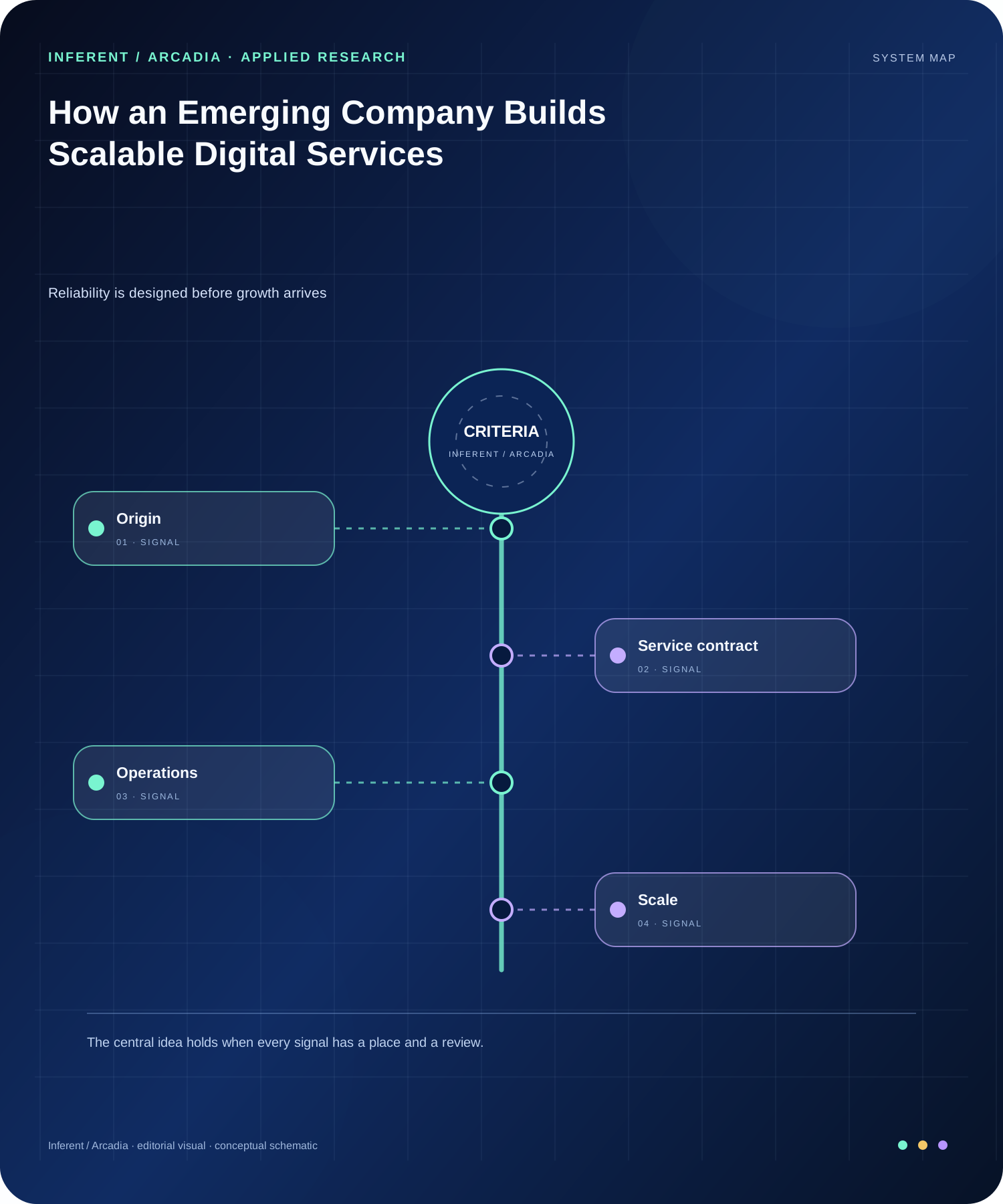
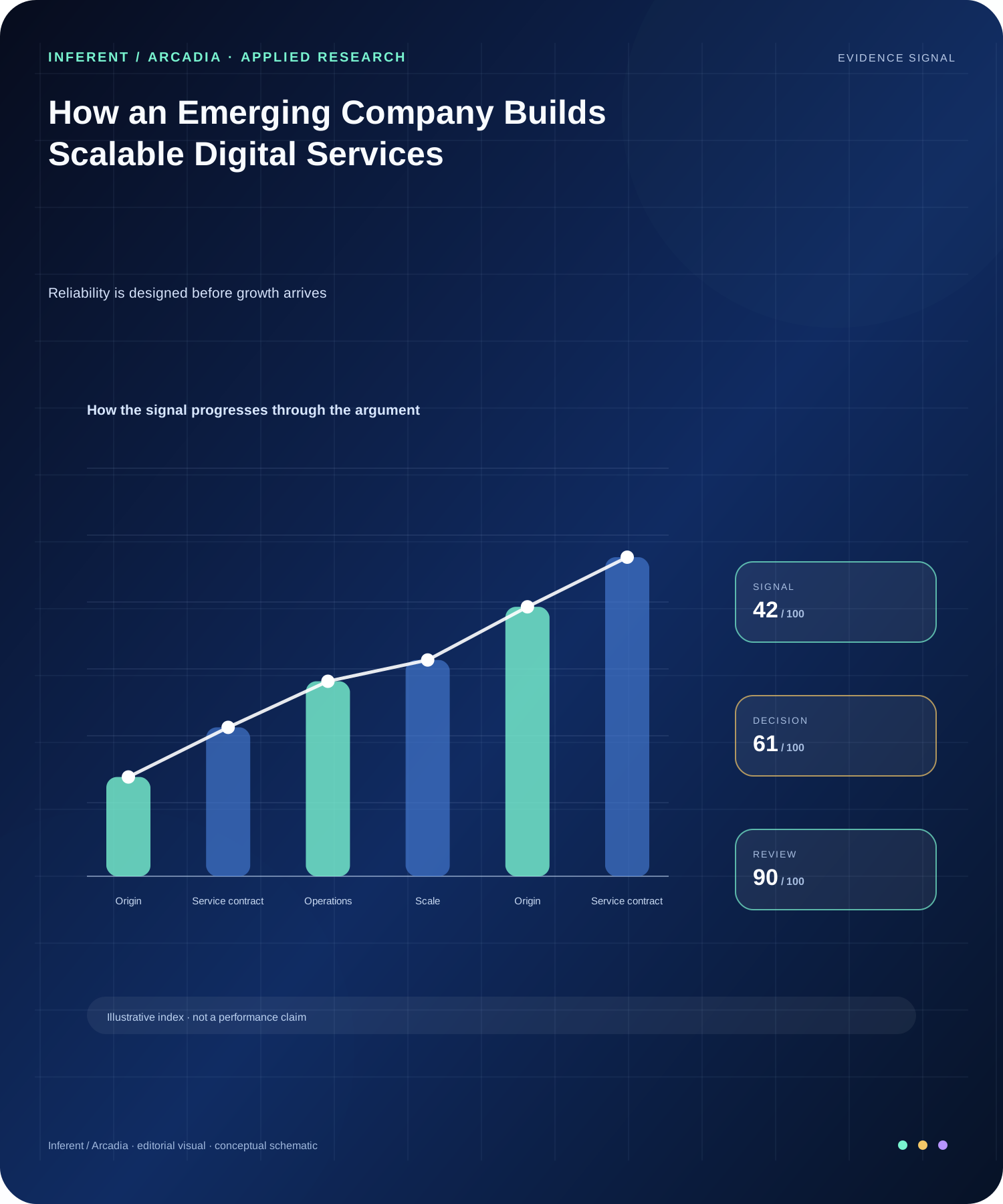
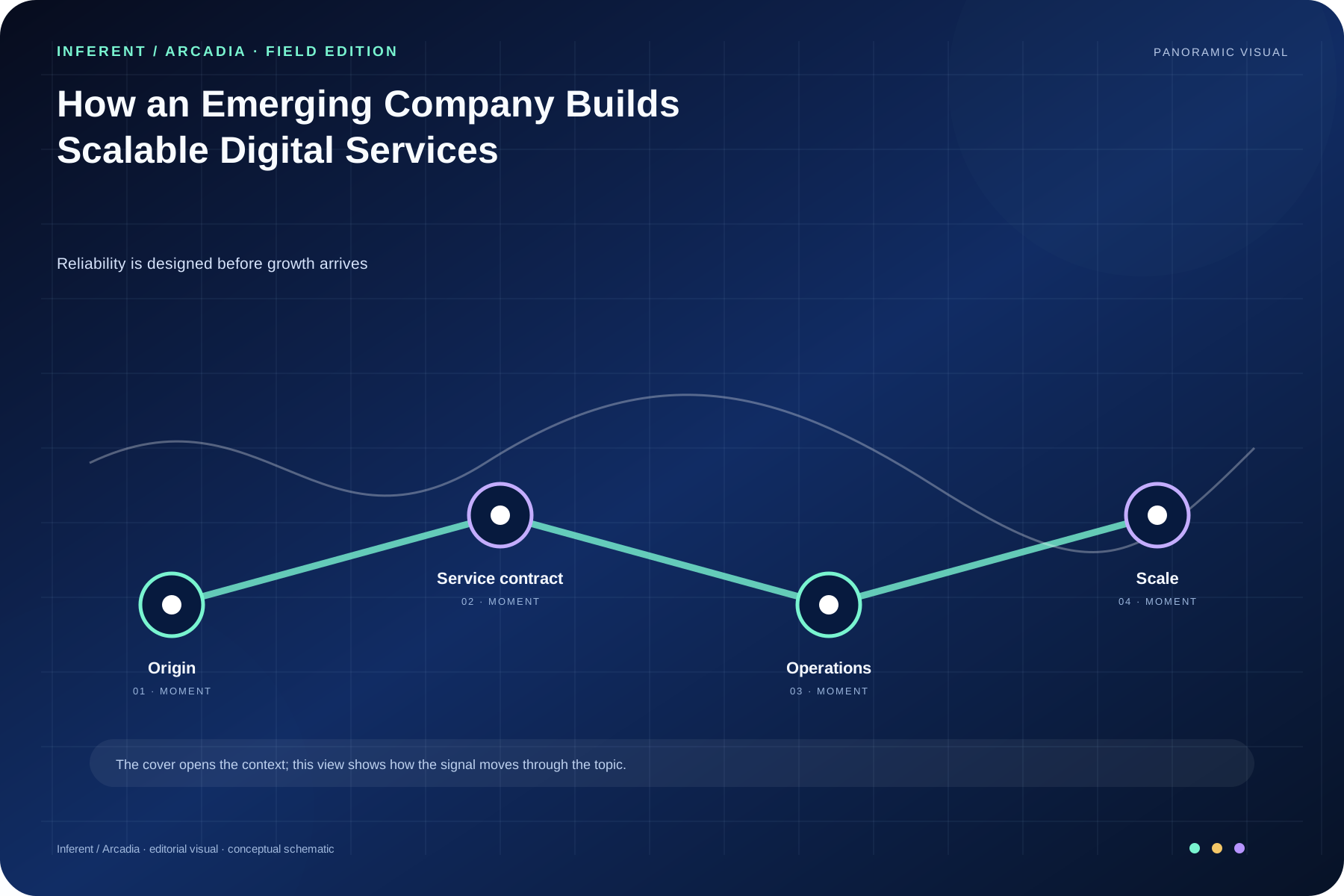
Method note: this article separates the promise, the operating choices, and the evidence required to know whether the promise is becoming real.
References consulted
Primary sources and standards used to frame this article:
- MACH Alliance · MACH Principles · Open source
- Wiggins · The Twelve-Factor App · Open source
- Google · Site Reliability Engineering · Open source
- DORA · Accelerate State of DevOps Report · Open source