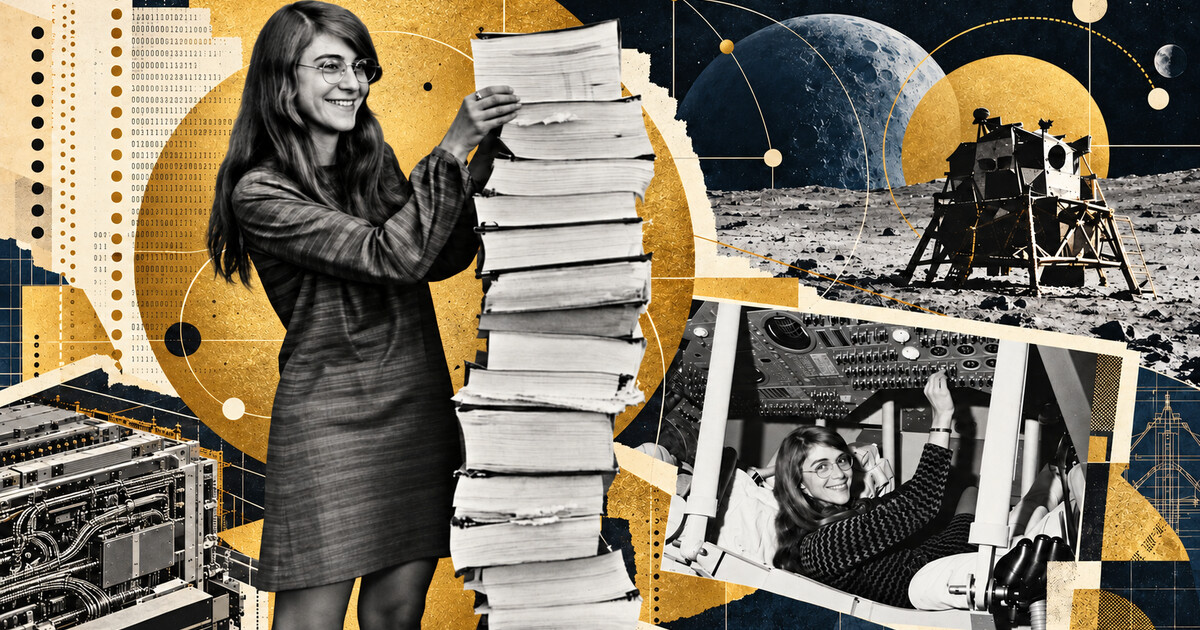

On October 7, 2026, MIT announced that Margaret H. Hamilton had died on September 30, aged 90. The news closes a remarkable life, but not the story of her work: the software practices she helped build now sit beneath almost every spacecraft, aircraft, hospital system and digital service.

Margaret Hamilton in a recent portrait. Photo: Toan Trinh, MIT Technology Review / MIT News.
From mathematics to the control room
Born in Paoli, Indiana, on August 17, 1936, Hamilton studied mathematics and philosophy at Earlham College, graduating in 1958. She moved to Boston in 1959 with her husband, who was pursuing a law degree, and soon took a temporary position in MIT’s meteorology department. There she programmed weather-prediction models with professor Edward Lorenz; it was her first work in computing.
At MIT’s Lincoln Laboratory, she worked on the SAGE air-defense project, helping develop software that processed radar data and detected potentially hostile aircraft. The work demanded reliability under pressure. It also gave Hamilton experience in systems where a software error could have consequences far beyond a computer screen.
SAGE was a large real-time defense network: radar information had to be processed quickly enough to help operators interpret the air picture. Hamilton later recalled that when a program crashed, warning lights and bells brought programmers and operators to the computer. Reliability was not an abstract quality; it was visible, testable, and operationally urgent. At Lincoln Laboratory she began to focus on how software could detect errors and keep the larger system usable.
Building Apollo’s software
In 1965, Hamilton joined the MIT Instrumentation Laboratory, which was seeking people to develop software for the Moon missions. She became the first programmer on MIT’s Apollo project and the first woman programmer hired for it. She began on uncrewed Apollo missions and was later promoted to lead the team developing onboard flight software for crewed missions. By 1968, she was assistant director in charge of the Command and Service Module team; more than 400 people were working on Apollo software.
Her team also designed how the computer would communicate with its crew. Priority displays could interrupt ordinary readouts to put an urgent message in front of astronauts, while recovery routines shed lower-priority work and restored essential tasks. This human-machine design made an alarm actionable: it signaled what the computer was doing and helped the crew understand what mattered next.
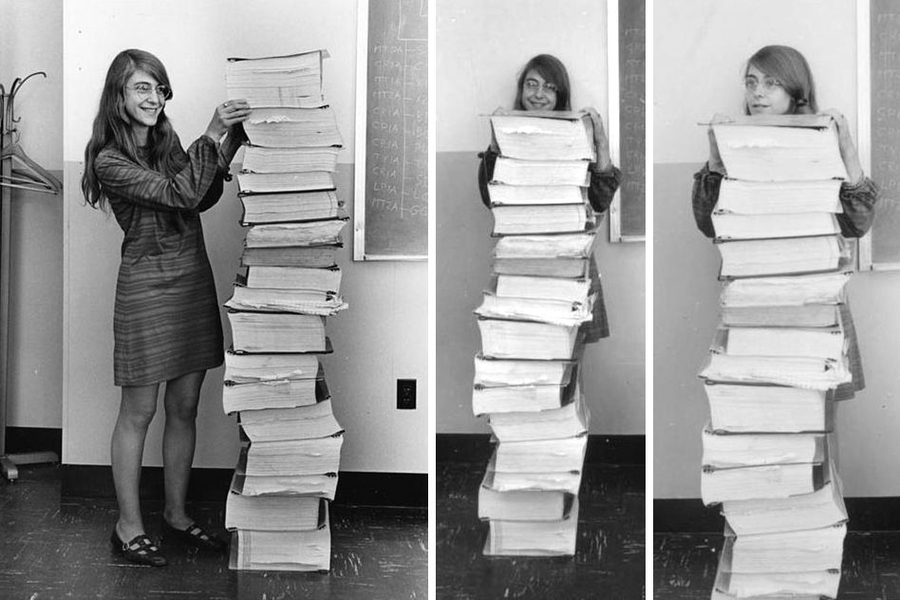
Hamilton beside the printed Apollo guidance software developed by her teams at MIT. Photo: MIT News, with photos via MIT Museum.
The team designed the software to prioritize essential work and recover from unexpected conditions. During Apollo 11, the guidance computer issued 1202 and 1201 alarms moments before landing. A hardware-switch fault overloaded the computer; the software recognized the overload, set aside lower-priority tasks, and ran recovery routines so the guidance functions needed for landing could continue. Mission Control cleared the crew to proceed, and the descent continued.
Hamilton’s daughter Lauren, then four, once activated the prelaunch P01 program while playing with a command-module simulator in midflight, crashing the simulation. Hamilton added a warning to the documentation and proposed a software safeguard, but the change was initially rejected because trained astronauts were not expected to make that mistake. In 1968, during Apollo 8, astronaut Jim Lovell inadvertently launched P01 in flight and the spacecraft’s navigation data disappeared. Hamilton and her team solved the problem, and the safeguard was later added. The Computer History Museum recounts that the team spent hours examining the printed program listing and worked out a careful recovery sequence for the crew. The episode became a practical lesson in defensive programming: anticipate human error and design systems to recover.
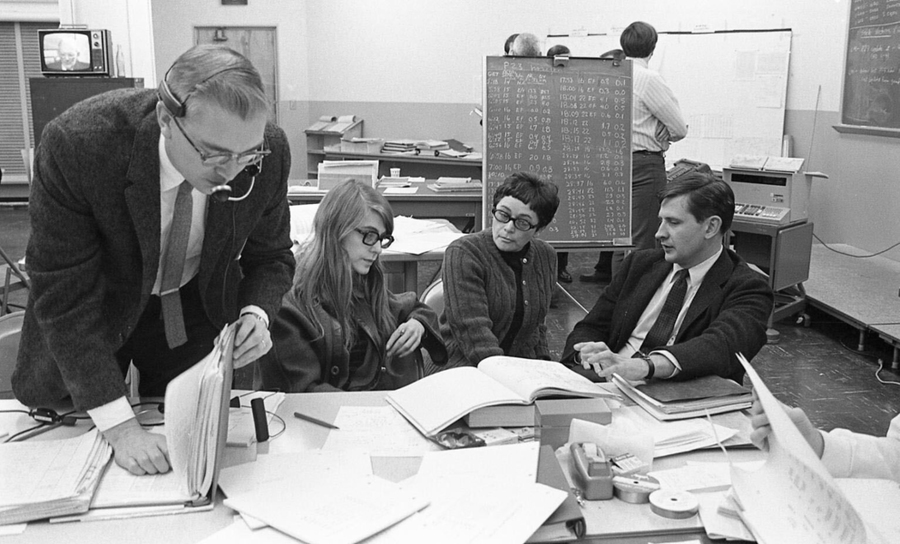
Hamilton (second from left) with colleagues discussing software for Apollo 8. Photo: MIT Museum via MIT News.
A discipline takes shape
Hamilton championed rigorous testing, clear documentation, and designing for failure, and helped make software engineering visible as a serious engineering discipline. She later said she adopted the term “software engineering” partly to give the work the respect accorded to other branches of engineering. Her photographs beside stacks of printed code became an enduring image of the scale and care involved.
After Apollo, Hamilton co-founded Higher Order Software in 1976 and founded Hamilton Technologies in 1986, continuing to develop methods for reliable systems. Her honors included NASA’s Exceptional Space Act Award (2003), the Presidential Medal of Freedom (2016), the Computer History Museum Fellow Award (2017), the Intrepid Lifetime Achievement Award (2019), and induction into the National Aviation Hall of Fame (2022).
Hamilton also contributed to software for Skylab and the Space Shuttle. At Hamilton Technologies, she developed the Universal Systems Language (USL) and the 001 Tool Suite, designed to model systems before implementation and support error prevention throughout development.
MIT notes that Hamilton authored more than 130 publications. The scale of that written record reflects a career devoted not only to building systems, but also to making their methods legible, discussable, and reusable beyond a single mission.
The scale of the effort is easy to miss when the story is reduced to a single photograph. Apollo software was built through disciplined collaboration among programmers, engineers, astronauts, and mission controllers. Hamilton’s leadership linked those groups: requirements had to become code, code had to survive simulations and reviews, and displays had to make the computer’s priorities legible to a crew working under pressure. She later described the work as a process of designing, developing, watching the software perform, and carrying what the team learned into future systems.
Beyond the iconic code photograph
Recognition arrived in layers. The Apollo source code was released on GitHub in 2015, making the scale of the teams’ work newly tangible to programmers around the world. A year later, President Barack Obama awarded Hamilton the Presidential Medal of Freedom, the United States’ highest civilian honor. In 2017, she was included in LEGO’s Women of NASA set. These public images helped introduce her to new generations, but the substance of her legacy remains the engineering method behind them: treat software as part of a larger system, anticipate the unexpected, and make recovery a design requirement.
The legacy beneath the mission
Hamilton’s achievement was not a single algorithm or a lone moment at a console. It was the creation of methods, teams and habits that helped software behave predictably when the stakes were highest. Apollo’s astronauts were visible to the world; the code that helped guide them was largely invisible. Hamilton made that invisible engineering harder to overlook.
Sources: MIT News obituary; NASA biography; Computer History Museum profile; Draper profile.