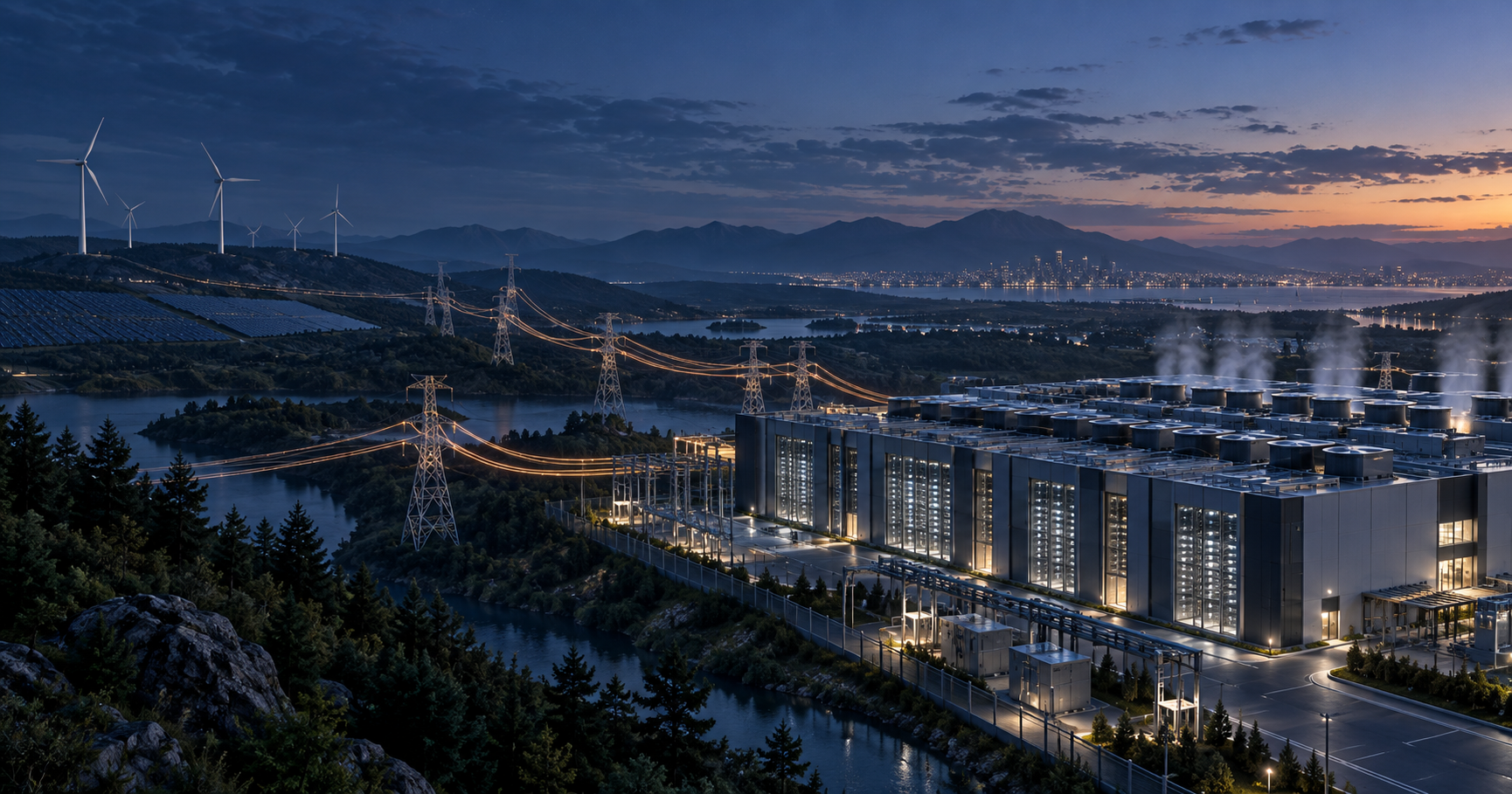

Artificial intelligence is often presented as software, but its next constraint may be physical: electricity. Every new model, agent and digital service depends on data centres that must be powered, cooled, connected and operated continuously. The strategic question is no longer only who has the best chips. It is who can secure reliable energy, transmission capacity and a credible plan for the environmental cost of computation.
The International Energy Agency’s 2026 analysis makes the change visible. Electricity demand from data centres increased by 17% in 2025, while consumption from AI-focused data centres grew by 50%. In the IEA’s base case, global data-centre electricity consumption more than doubles to around 945 terawatt-hours by 2030, just under 3% of total global electricity use. That share may look modest at a global level, but the infrastructure is highly concentrated, so local pressure can be much greater.
The hidden cost of scaling intelligence
When an AI service feels weightless on a screen, the physical system behind it disappears from view. Training and inference require accelerators, memory, networking equipment and cooling. A short answer from a small model and a long, tool-using workflow do not have the same energy profile. Neither do a request processed during a period of abundant renewable generation and one processed at a constrained local grid connection.
This matters because demand is becoming more dynamic. AI workloads can run continuously, expand rapidly after a product launch and compete with households, factories and public services for the same infrastructure. The result is a shift in the economics of technology: access to compute is increasingly linked to access to power, and the price of a digital service may eventually reflect the cost of the grid that makes it possible.
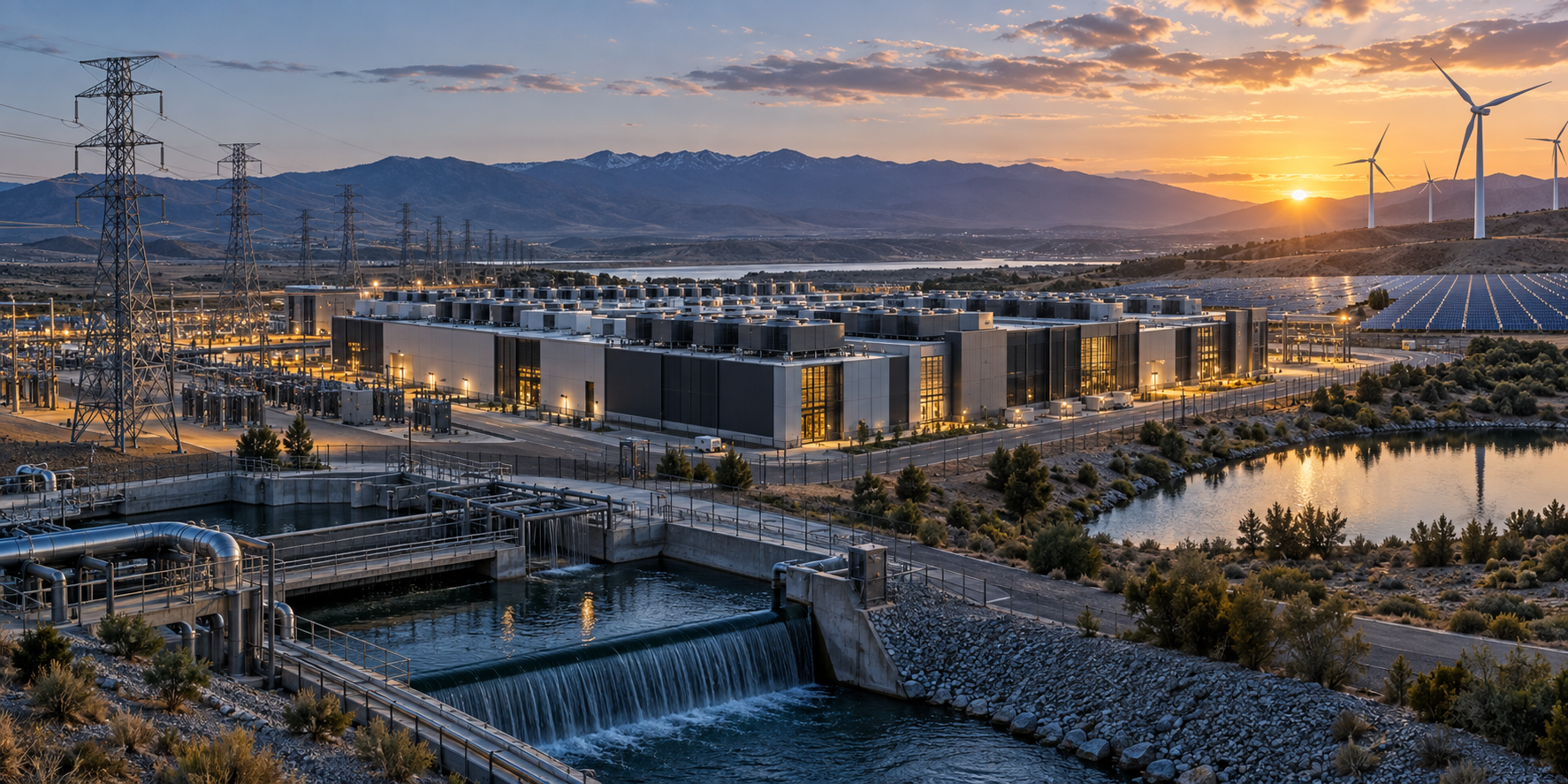
AI infrastructure now depends on electricity, water, land and the reliability of the grid.
The bottleneck is moving from chips to grids
More processors do not automatically create more useful AI capacity. A data centre needs an interconnection, substations, transmission lines, backup systems, cooling and a stable operating environment. The IEA estimates that grid constraints could delay around 20% of the global data-centre capacity planned for construction by 2030. That is not simply a construction problem. It is a signal that digital growth is becoming part of energy planning.
The consequence is a new competition among locations. Regions with abundant electricity but weak networks may struggle to connect new facilities. Regions with strong grids may face land, water or permitting constraints. Areas with low-carbon power may still need storage, firm capacity and transmission to match a workload that does not respect the rhythm of weather or the geography of generation.
Clean power is necessary, but not sufficient
It is tempting to reduce the debate to a binary question: is AI powered by renewable energy or by fossil fuels? The more useful question is whether the entire system is becoming more efficient and resilient. A renewable contract does not remove the need for local grid capacity. A new data centre can increase demand at the same time that other users are exposed to higher prices or reliability risks. A power purchase agreement can support new generation, but its real impact depends on when and where that energy is delivered.
A serious sustainability strategy should therefore measure more than annual consumption. It should disclose the source and timing of electricity, the efficiency of the facility, the water implications of cooling, the emissions associated with construction and the degree to which workloads can be moved to less-constrained periods or locations. Transparency is not a branding exercise here; it is a way to compare competing infrastructure choices.
Why this matters for Mexico and Latin America
Mexico and the rest of Latin America have a credible opportunity to participate in the next phase of digital infrastructure. Proximity to major markets, growing connectivity, renewable resources and a young technical workforce are valuable advantages. But attracting data-centre investment is not the same as creating a sustainable AI ecosystem.
Public policy and private investment will need to connect several decisions that are often handled separately: transmission planning, water management, industrial permitting, cybersecurity, data governance, local talent and the price of electricity for surrounding communities. If a project is announced before its energy and water requirements are credible, the headline investment may not translate into operating capacity. If infrastructure is planned without local accountability, the social licence to expand can deteriorate.
A practical operating agenda
Companies deploying AI can act before regulation forces every answer. They can choose smaller or specialised models when the task does not require frontier capability; cache repeated work; measure energy and latency alongside accuracy; schedule flexible workloads; establish procurement standards for efficient hardware; and require vendors to disclose how they calculate emissions and resource use.
They can also treat location as a technical decision. The best site is not necessarily the one with the cheapest land or the largest tax incentive. It is the location where energy reliability, transmission access, cooling, water, cybersecurity and community impact can be managed together. That evaluation may slow an initial deployment, but it reduces the risk of building a digital asset that cannot scale.
From invisible utility to strategic infrastructure
AI will continue to create value, but its growth will be negotiated with the physical systems that support it. Electricity is not a side issue for the sector; it is an operating input, a competitive advantage and a public-policy question. The companies that understand this early will design more efficient products, make better infrastructure decisions and communicate with greater credibility.
The future of AI will not be powered by ambition alone. It will depend on whether computation can be expanded without treating energy, water, land and grid reliability as invisible externalities. The most resilient AI ecosystem will be the one that can explain not only what its models can do, but also what it requires from the world in order to do it.
AI’s growth now connects computation with electricity, grids and energy planning.
The first mistake: treating electrons as a line item
The most common strategic mistake is to treat electricity as a variable cost that can be added to a spreadsheet after the product has already been designed. For an AI company, that order is increasingly backwards. The location of servers, the type of accelerator, the cooling architecture and the rhythm of workloads all shape the product’s economics before a single customer is billed. A model that appears inexpensive at the API layer can depend on a physical system with long lead times, scarce components and a constrained connection to the grid.
This changes the meaning of operational efficiency. Efficiency is not only a matter of using fewer kilowatt-hours per inference. It is also the ability to deliver a predictable service when electricity prices move, when a transmission project is delayed or when a facility cannot operate at full capacity. Reliability, redundancy and flexibility become part of the customer experience. If a provider cannot explain how its infrastructure behaves during a peak, a heat wave or a local outage, its energy strategy is incomplete.
From capacity to flexibility
Grid planning has traditionally focused on how much capacity exists at a given moment. AI adds a second question: how flexible is the demand? Some training jobs can be scheduled around cleaner or cheaper electricity, moved between regions or paused without affecting a customer-facing service. Other workloads, especially real-time inference, search, translation and safety systems, require low latency and continuous availability. Treating both categories as if they had the same energy profile leads to poor investment decisions.
A mature operator should therefore classify workloads according to latency, criticality, geographic constraints and the possibility of interruption. Flexible training can become a tool for balancing demand, while mission-critical inference needs firm capacity and stronger redundancy. This classification also makes procurement more intelligent: the company can buy high-reliability capacity for the services that need it and use more flexible arrangements for workloads that can tolerate movement. The result is not simply a lower bill. It is a more resilient architecture.
Models change the shape of demand
AI electricity demand is not determined only by the size of a model. It depends on how frequently the model is called, how long prompts and outputs are, whether responses are cached, which hardware is used, how efficiently the software batches requests and how much computation is spent on reasoning or verification. Product decisions can therefore have infrastructure consequences. A feature that adds an additional model call to every user action may look minor in a product review but become material at millions of interactions.
This is why energy measurement should be connected to product analytics. Teams should know the energy and latency implications of a feature, not just its conversion rate or engagement. The goal is not to reduce every interaction to a single environmental number. It is to create enough visibility for a product manager to compare alternatives: a smaller model with a slightly lower score, a cached answer with less latency, or a batch process that runs during a less constrained period. Better measurement allows better trade-offs.
The geographic problem
Data centres are not interchangeable boxes that can be placed anywhere with an internet connection. They need land, substations, transmission access, fibre routes, cooling resources, skilled workers, permits and a social environment that can accept their presence. A region can have abundant annual renewable generation and still lack the local transmission capacity needed to serve a new facility at the hour it wants to operate.
That distinction is especially important when investment announcements are interpreted as proof that capacity already exists. A signed project, a reserved plot and a power-purchase agreement are not the same as an energised, permitted and reliable data centre. The distance between those stages can involve years of construction, transformer availability, environmental review and negotiations with local communities. Strategic planning should report these milestones separately instead of placing them under one headline number.
Water, heat and the local contract
Every large computing facility must manage heat. The choice between air cooling, evaporative systems, direct-to-chip liquid cooling or other designs affects water use, energy efficiency, maintenance and the facility’s ability to operate in a changing climate. The right solution will vary by location and workload, but the decision should be visible to stakeholders who live near the project. Water cannot be treated as an invisible input simply because the digital service is delivered elsewhere.
The local contract also includes noise, land use, construction traffic and the distribution of economic benefits. A data centre can bring investment and technical jobs while still creating legitimate concerns about infrastructure pressure or public resources. Companies that publish clear water, energy and community metrics are more likely to build trust than companies that rely only on a promised number of jobs. Transparency does not eliminate disagreement, but it creates a basis for evaluating whether a project is delivering what it promised.
What procurement should ask
Procurement teams are becoming an important point of leverage. When they buy cloud capacity, accelerators or colocation services, they should ask where the electricity comes from, how the provider defines renewable supply, how it handles peak demand and whether its efficiency figures include cooling and facility overhead. They should also ask what happens if the promised connection or generation project is delayed.
Contracts can include reporting requirements, audit rights, service-level commitments for power availability and clauses that distinguish annual renewable matching from hourly or regional delivery. These details may appear technical, but they determine whether a sustainability claim describes the physical operation of a facility or merely an accounting arrangement. The best procurement documents make the assumptions explicit and give decision-makers a way to compare providers on reliability as well as price.
Measurement without false precision
There is a temptation to publish one universal number for the energy cost of an AI query. That number can be useful as an estimate, but it should not be presented as a timeless physical constant. Hardware changes, model architectures evolve, regions use different electricity mixes and user behaviour determines how much computation is requested. A credible disclosure should explain the boundary of the measurement, the period observed and the assumptions behind the estimate.
Companies can combine several layers of reporting: facility efficiency, electricity consumption, workload intensity, water use, emissions and the share of demand that can be shifted. They can then show trends rather than pretend that one figure answers every question. This approach also reduces the risk of greenwashing. A lower energy number is meaningful only when it is not achieved by moving the burden to another region, outsourcing the least transparent part of the supply chain or ignoring the embodied impact of new equipment.
Mexico and Latin America: opportunity with conditions
Mexico and Latin America can participate in the expansion of AI infrastructure, but the opportunity should be evaluated as an industrial strategy rather than a race to announce the largest facility. Connectivity, renewable potential, engineering talent and proximity to the United States are valuable advantages. They become durable advantages only when combined with predictable permitting, modern transmission, water planning, cybersecurity and a credible framework for communities affected by new infrastructure.
For the region, the most attractive projects may not be the largest hyperscale campuses. There is room for smaller regional facilities, specialised inference capacity, research clusters and services that help businesses use models efficiently. A diversified ecosystem can create more local value than a single project that imports hardware, exports most of the economic benefit and competes with households or existing industries for constrained resources.
Public policy should connect separate decisions
Energy policy, digital policy and industrial policy are often designed in separate rooms. AI exposes the cost of that separation. A decision to approve a large computing load affects transmission planning; a decision about water affects permitting; a decision about data governance affects where workloads can be processed; and a decision about tariffs affects whether smaller firms can compete with very large buyers.
Governments do not need to prescribe one technical architecture, but they do need information that makes trade-offs legible. Planning authorities can require credible demand projections, connection milestones, water assessments and community commitments. Regulators can encourage flexible loads and transparency without assuming that every facility has the same operating profile. The objective is not to slow innovation. It is to prevent innovation from being built on assumptions that fail when the physical system is tested.
Questions for boards and product leaders
Boards evaluating an AI strategy should ask whether the company knows the physical constraints behind its growth plan. How much of the projected demand depends on a single region or supplier? Which workloads can move? What is the plan if a connection is delayed? Does the company measure energy, water and reliability at the level where product decisions are made? Can it explain which environmental claims describe direct operation and which rely on certificates or accounting instruments?
Product leaders should ask a parallel set of questions. Is a larger model genuinely required for the user outcome? Can a feature reuse an earlier result? Can the service offer different quality and latency modes? Are customers given information that helps them choose an efficient option? These questions turn sustainability from a communications layer into a design discipline. They also make products more robust because they force teams to understand the conditions under which the service can continue to work.
Infrastructure literacy is now a competitive capability
The next phase of AI will reward companies that understand both computation and the systems that make computation possible. Electricity, transmission, cooling, water, land and permitting are not external details that can be delegated indefinitely. They are part of the operating model. Companies that build this literacy early will be better positioned to choose sites, negotiate contracts, design products and communicate honestly with customers and communities.
The strategic question is therefore not whether AI should grow. It is how that growth can become compatible with the limits of the physical world. A resilient AI business will measure what it consumes, design for flexibility, invest in reliability and treat local legitimacy as an infrastructure asset. That is the path from a promising digital service to a durable technology platform.
Product design and electricity consumption
Energy efficiency is also decided in the interface. A feature that generates an unnecessarily long answer, requests several checks or calls the model again after every click can multiply consumption without the user noticing. Designing with clear limits, reusable responses and different quality modes can make the experience faster while making infrastructure more predictable.
This does not mean sacrificing quality. It means reserving expensive computation for the cases that justify it. A system can use smaller models to classify a request, specialised models for narrow tasks and larger models only when there is a verifiable reason. A hybrid architecture can improve cost, latency and availability at the same time, especially when product teams understand which parts of the experience actually require frontier capability.
The grid connection is not an administrative detail
In a computing project, the electricity connection often appears as one item in a permitting checklist. In reality, it is a product dependency. The arrival of a transformer, the firm capacity available and the ability to expand a substation determine when a facility can operate. If those assumptions are not documented, a commercial calendar can promise a scale that the physical system cannot yet support.
Companies should distinguish announced capacity, contracted capacity, capacity under construction and capacity that is actually available to workloads. They should also explain which parts of expansion depend on works outside their control. This separation helps investors, customers and communities distinguish a growth ambition from physical capability that has already been demonstrated.
The operating value of flexibility
Flexibility can become a commercial advantage. Workloads that can change time or location make it possible to respond to prices, congestion and availability without interrupting critical services. Achieving that flexibility requires orchestration software, suitable contracts, reliable data and a clear policy about which tasks can be paused. It is not an automatic property of the cloud.
Teams should also rehearse periods of scarcity. A responsible operating plan can define priorities, temporarily reduce the quality of a non-critical task, use more aggressive caching or move training to another site. These decisions need to be tested before a crisis. An architecture that looks flexible on paper can become rigid when customers and internal teams depend on it.
Financing infrastructure with a long horizon
Energy infrastructure is built on timelines that are longer than product cycles. An application can change direction in weeks, while a substation, transmission line or supply agreement can require years. That mismatch creates a risk of overcommitment: a company may reserve capacity for demand that changes, or discover that its product is growing just as the local grid becomes constrained.
The answer is not to stop investing but to build scenarios. Plans should consider rapid growth, moderate adoption and a constrained environment. Each case should show the capacity required, the investments that can be reversed and the signals that would justify the next stage. Scenario discipline is more useful than a single projection presented as certainty.
Transparency for customers and communities
Energy information should not remain confined to specialist reports. Enterprise customers need to know what availability commitments they can expect and what renewable-energy claims actually mean. Communities need information about water, noise, construction duration, expected employment and channels for complaints. Explaining limits is more credible than promising unlimited positive impact.
Trust is also built through updates. A project that communicates a delay, corrects an estimate and publishes verifiable progress can retain legitimacy. Silence allows an early number to become the only public reference even after conditions have changed. Regular reporting should distinguish what is measured directly, what is estimated and what remains uncertain.
A twelve-month operating agenda
In the first quarter, a company can establish a consumption baseline, separate training from inference and document supplier dependencies. In the second, it can measure the effect of caching, specialised models and shiftable workloads. In the third, it can renegotiate contracts with clearer efficiency and availability indicators. In the fourth, it can publish the results and revisit its growth scenarios.
This agenda does not depend on one technology. It depends on assigning ownership, turning data into decisions and treating energy, water and reliability as operating metrics. When those metrics reach product and finance teams, they stop being an abstract sustainability promise and become a management capability.
What a credible infrastructure scorecard includes
A useful scorecard can begin with six questions. How much electricity did the workload use at the facility boundary? What portion of demand was flexible? What was the peak load and how did it affect the local system? How much water was consumed or withdrawn for cooling? How efficient was the hardware and facility together? Which claims are based on physical delivery and which rely on certificates or market instruments?
The scorecard should be read with context. A facility with a higher annual renewable share may still create stress during a local peak. A site with lower water consumption may require more electricity. A workload moved to a cleaner region may increase latency or raise other infrastructure costs. The value of the scorecard is not to produce one winner, but to make the trade-offs visible enough for a responsible choice.
Hardware life cycles matter
Electricity during operation is only one part of the infrastructure story. Accelerators, networking equipment and cooling systems also have manufacturing, transport, maintenance and end-of-life impacts. Rapid replacement can improve performance while creating a large material footprint. Procurement decisions should therefore consider useful life, repairability, resale, recycling and the possibility of using less specialised hardware for lower-intensity tasks.
Longer hardware life is not always automatically better. Old equipment can consume more electricity for the same result, and a newer accelerator may reduce the energy required for a workload. The appropriate comparison is system-level performance over time, including the energy used to operate, manufacture and replace the equipment. This is another reason why simple headline metrics can mislead when separated from their boundary.
Security and resilience are energy questions too
Redundancy, backup generation and physical security consume resources, but removing them can make a service fragile. AI systems used in health, finance, public administration or safety-sensitive contexts may need stronger continuity guarantees than a consumer experiment. The right question is not whether resilience has a cost; it is whether the cost is proportional to the consequence of failure.
Resilience planning should include cyber incidents, fuel interruptions, extreme weather, cooling failures and supplier concentration. A company that depends on one region, one cloud provider or one hardware pipeline may have an efficient normal case but a weak system under stress. Diversification can cost more in the short term while protecting customers and reducing the chance of a disruptive emergency.
Why smaller systems can be strategic
The discussion often assumes that the future belongs only to the largest models and campuses. In practice, smaller systems can be strategically important because they reduce latency, support local processing, lower transfer costs and allow more organisations to control sensitive workloads. A specialised model that solves a narrow problem well may create more value than a general model that uses substantially more computation for a marginal improvement.
This is relevant for Latin America, where regional services can address language, regulation, geography and sector-specific needs. Efficient inference close to users can improve performance and reduce dependence on a distant facility. It does not remove the need for large-scale infrastructure, but it creates a more distributed and adaptable ecosystem.
From disclosure to accountability
Disclosure is the beginning of accountability, not its conclusion. A company should define who reviews its energy assumptions, who can challenge a projection and what happens when a target is missed. It should preserve the data behind an environmental claim, identify the methodology used and publish material changes rather than quietly replacing a baseline.
Accountability also requires trade-offs to be acknowledged. A company may choose a more reliable site with a higher cost, a slower deployment with stronger water planning or a smaller model with less impressive benchmark performance. Explaining those choices can strengthen credibility because it shows that the organisation is managing a real system rather than presenting sustainability as a slogan.
A strategic conclusion
The next generation of AI companies will be judged not only by the intelligence of their models but by the quality of the systems that support them. Electricity, land, water, transmission, hardware and local consent will shape the speed and durability of growth. The strongest operators will integrate these constraints into product design, finance, procurement and public communication.
That is not a reason for pessimism. It is an invitation to build better technology. A service that uses computation carefully, shifts flexible demand, reports honestly and plans for local conditions can be more reliable and more competitive. The physical world is not an obstacle outside the AI strategy. It is where the strategy becomes real.
Why this matters for Mexico and Latin America
Mexico and the rest of Latin America have a real opportunity to participate in the next phase of digital infrastructure. Proximity to major markets, expanding connectivity, renewable resources and a young technical workforce can support new investment. But attracting data centres is not the same as building a sustainable AI ecosystem. The value created by a facility depends on the quality of its jobs, the reliability of its supply chain, the skills that remain in the region and the public costs that accompany its operation.
Energy planning must be connected to data policy. A region may host a facility that processes information for foreign clients while retaining little technical capacity or negotiating power locally. It may also receive a project that requires large amounts of electricity and water without a clear plan for community benefits. Public authorities should evaluate not only the headline investment, but also the expected load, the source and timing of electricity, the water balance, the local grid upgrades, cybersecurity, tax terms, training commitments and the possibility of future expansion.
Mexico’s geography creates different conditions rather than one national answer. A site near a strong industrial corridor may have connectivity and suppliers but face water stress or grid congestion. A site with renewable potential may need transmission, storage, specialized maintenance and new telecommunications. A site near a city may offer a workforce and customers while intensifying land and community pressures. A serious strategy compares these trade-offs instead of treating every region as interchangeable.
Local communities should be part of the infrastructure conversation. Consultation should happen before major commitments are irreversible and should explain the project in accessible terms. People need to understand expected resource use, employment, traffic, construction, emergency planning and the conditions under which the facility could expand. Community participation is not an obstacle to innovation. It is a way to identify risks early and build the legitimacy needed for long-lived infrastructure.

What regulators should ask
Regulators do not need to predict every future AI application to improve decision-making today. They can ask a manageable set of questions. What is the facility’s maximum and expected load? How will the operator measure energy and water use? What happens during drought or a grid emergency? Which upgrades are paid by the operator and which by the public? How will the operator protect data and respond to a cyber incident? What information will be reported to the public, and how often?
They can also require scenario analysis. A project should show what happens if demand is lower than forecast, if the model mix changes, if hardware becomes denser, if a connection is delayed or if water restrictions intensify. Scenarios make plans more credible because they expose the conditions under which a project remains viable. They also help communities and grid operators compare projects instead of evaluating each proposal as an isolated promise.
Environmental disclosure should be tied to accountability. If a company reports an efficiency target, it should explain the baseline, the boundary of measurement, the method of calculation and the consequences of missing the target. If it announces renewable-energy procurement, it should identify whether the contract adds generation, when the energy is delivered and how local constraints are addressed. Clear definitions reduce greenwashing and allow the public to compare claims.
The European debate is relevant even for countries outside the European Union because it shows how AI policy is expanding beyond model behavior. The European Commission’s implementation of the AI Act and its newer attention to transparency around data-centre energy and water efficiency indicate that infrastructure, sustainability and digital governance are becoming connected fields. Mexico does not need to copy every European rule, but it can learn from the direction of travel: AI oversight increasingly includes the conditions that make computation possible.
A corporate checklist for responsible scale
Companies that deploy AI can act before every question is settled by regulation. They can choose smaller or specialized models when the task does not need frontier capability; reuse repeated computations; measure energy and latency with enough precision to compare alternatives; schedule flexible workloads; adopt procurement standards for efficient hardware; and ask providers how they calculate emissions and resource consumption.
They can also treat location as a technical decision. The best site is not necessarily the one with the cheapest land or the largest tax incentive. It is the site where energy reliability, transmission access, cooling, water, cybersecurity and community impact can be managed together. This assessment can slow an initial deployment, but it reduces the risk of building a digital asset that cannot scale, cannot operate during stress or loses public support.
Contract terms are part of this checklist. Customers should ask providers for service-level commitments, outage procedures, resource disclosures, data portability and notice before material changes. They should understand whether a provider can shift workloads to another region and what that shift means for data residency, latency and emissions. They should also avoid contracts that make it impossible to audit a system’s energy or water claims when those claims are relevant to a public commitment.
Internal governance should connect engineering and sustainability. A product review that asks only whether a feature is technically possible will miss the resource conditions that determine whether it is responsible. A sustainability review that ignores user value and reliability will produce targets that teams cannot implement. The most useful approach is a joint review with clear owners, measurable assumptions and an escalation path for conflicts.
Possible futures for AI infrastructure
There is no single inevitable trajectory. In one scenario, demand grows rapidly while grids, permits and supply chains adapt slowly. Prices rise, connection queues lengthen and communities push for stronger conditions. In another, efficiency improvements reduce the energy required for many tasks, but lower cost causes usage to expand enough that total demand still rises. In a third, flexible workloads, better transmission, storage and low-carbon generation allow growth without the same local pressure. Real outcomes will likely combine elements of all three.
The important point is that technology choices influence the scenario. Better model routing can reduce unnecessary inference. More transparent siting can avoid water-stressed regions. Grid-aware scheduling can move flexible computation to hours with less congestion. Heat reuse and reclaimed water can create local value when the surrounding infrastructure supports them. Standards can make these practices easier to compare, finance and scale.
Policy can shape incentives before systems become locked in. If a jurisdiction rewards only the amount of capital announced, it may attract projects that are difficult to operate. If it rewards reliability, skills, resource efficiency, transparency and community value, it can attract more durable infrastructure. The choice is not between growth and restraint. It is between growth that accounts for its requirements and growth that discovers those requirements through conflict.
From invisible utility to strategic infrastructure
AI will continue to create value, but its expansion must coexist with the physical systems that support it. Electricity is not a secondary issue for the sector. It is an operational input, a competitive advantage and a public-policy question. Companies that understand this early can design more efficient products, make better infrastructure decisions and communicate with greater credibility.
The future of AI will not depend on ambition alone. It will depend on whether computation can expand without treating energy, water, land and grid reliability as invisible externalities. The most resilient AI ecosystem will be the one that can explain not only what its models can do, but also what they require from the world in order to do it.
That explanation should be practical. It should tell users, regulators, investors and communities what is measured, what is estimated, what remains uncertain and what the operator will do when conditions change. It should connect a digital service to its physical footprint without pretending that a single number captures every consequence.
AI infrastructure is becoming strategic precisely because it is no longer separate from other systems. It interacts with energy security, industrial policy, water management, climate goals, regional development and national capability. Treating those questions as separate can produce elegant plans that fail at the point of implementation. Bringing them together creates a more demanding analysis, but also a more durable path to innovation.
The next generation of AI will be judged partly by its intelligence and partly by its discipline. It will be asked to deliver useful computation while respecting the limits of the places in which it operates. That is not a constraint external to innovation. It is the condition under which innovation can last.
References
International Energy Agency, Key Questions on Energy and AI, 2026.
IEA, Executive summary: electricity demand from data centres and AI.
Stanford University, The hidden transmission capacity of the American West.